
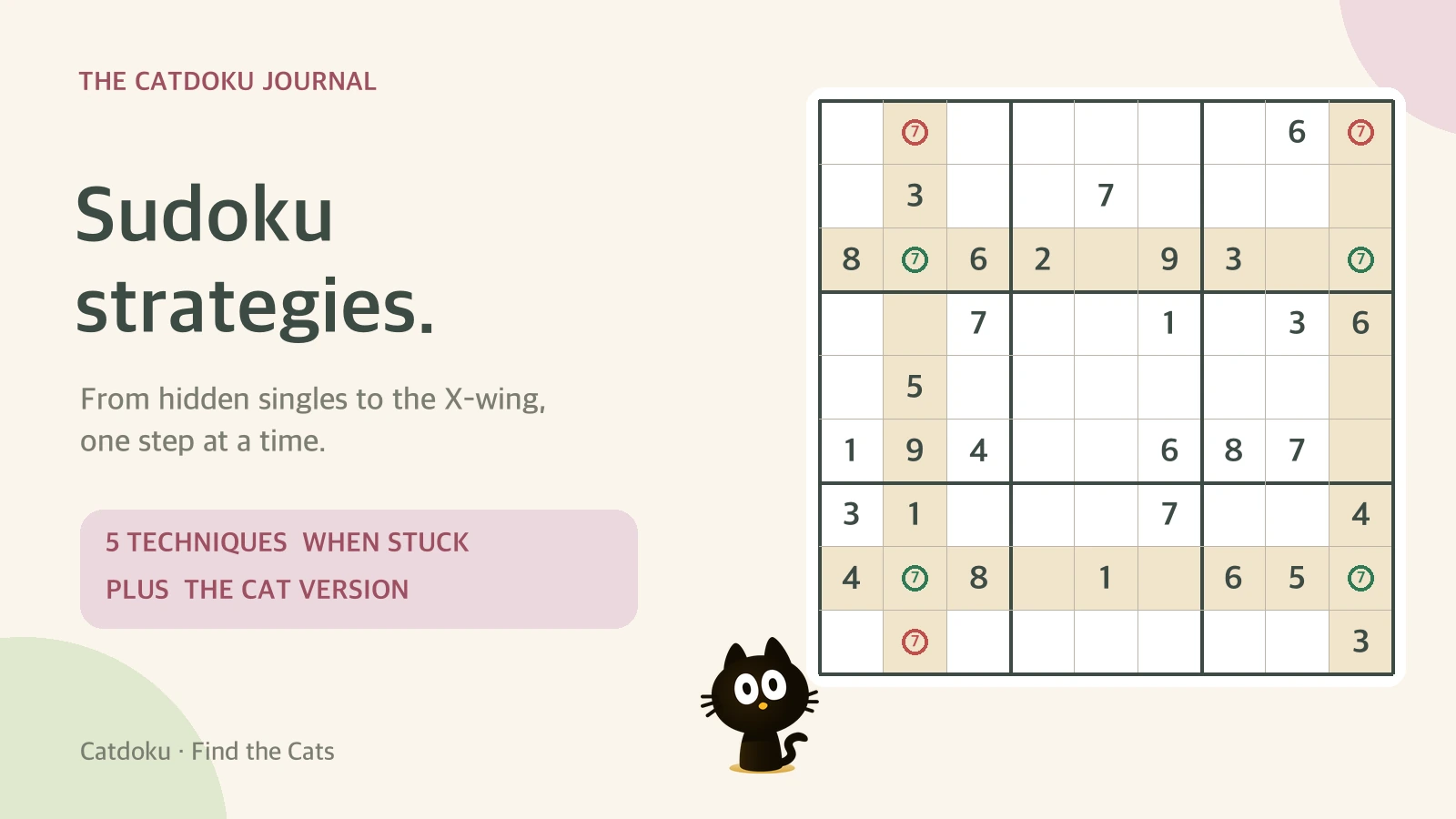
The best sudoku strategies all ask one question in different ways: where can this number still go, and what can this square still be? Start with hidden singles, add pencil marks for naked singles, then look for pointing pairs, naked pairs, and finally the X-wing.
Below: five techniques, easiest first, a routine for when you're stuck, and the same moves on Catdoku's cat boards.
Try today's free cat version →
The rule every strategy comes from
A sudoku is a 9×9 grid split into nine 3×3 boxes. You fill it so that every row, column, and box contains the numbers 1 to 9 exactly once.
Every technique below uses that "exactly once."
New to sudoku? Our how to play sudoku guide explains the rules and walks through a first solve on a 4×4 grid.
Hidden singles: where can this number go?
Pick a number and a box. Every 5 in a row or column that crosses the box rules out that whole line. If only one empty square in the box is left, the 5 goes there.
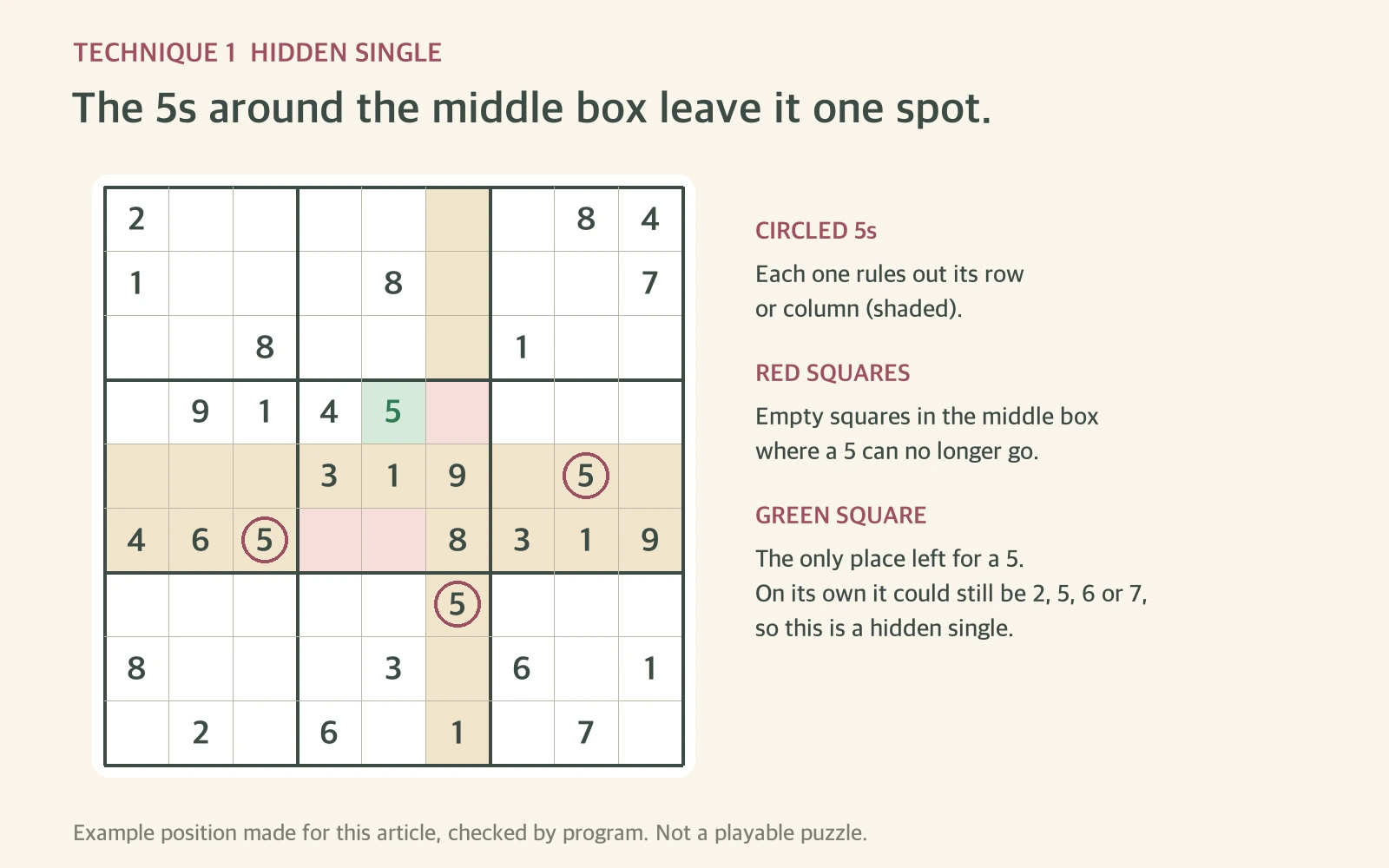
It is hidden because, looked at alone, the green square could still hold a 2, 5, 6, or 7. The single appears only when you ask where the 5 can go; SudokuWiki's getting-started guide shows this scanning.
A small program confirmed this position: its givens come from a valid finished grid, and the 5 has exactly one spot in the middle box.
Naked singles and pencil marks
A naked single is the reverse question: what can this square be? If the row, column, and box around a square already use eight different numbers, the ninth is the answer.
They are hard to spot by scanning, so use pencil marks: small candidate numbers in each empty square. The next three techniques need them too.
Pointing pairs and naked pairs
Pointing pairs. Suppose the top-left box can hold a 4 only in two squares, both in row 2. Its 4 must be in row 2, so no other square in row 2 can be a 4. SudokuWiki calls this intersection removal. In reverse, if a row's only spots for a number sit in one box, the rest of that box loses it. Many solvers call both versions locked candidates.
Naked pairs. If two squares in one row can each be only 3 or 8, they take the 3 and the 8 between them, so cross 3 and 8 out of the rest of the row. Columns and boxes work the same way, as SudokuWiki's page on naked candidates explains.
The X-wing: two rows, two columns
Take one number, say 7. If rows 3 and 8 each have only two squares where a 7 can go, and those squares share the same two columns, you have an X-wing.
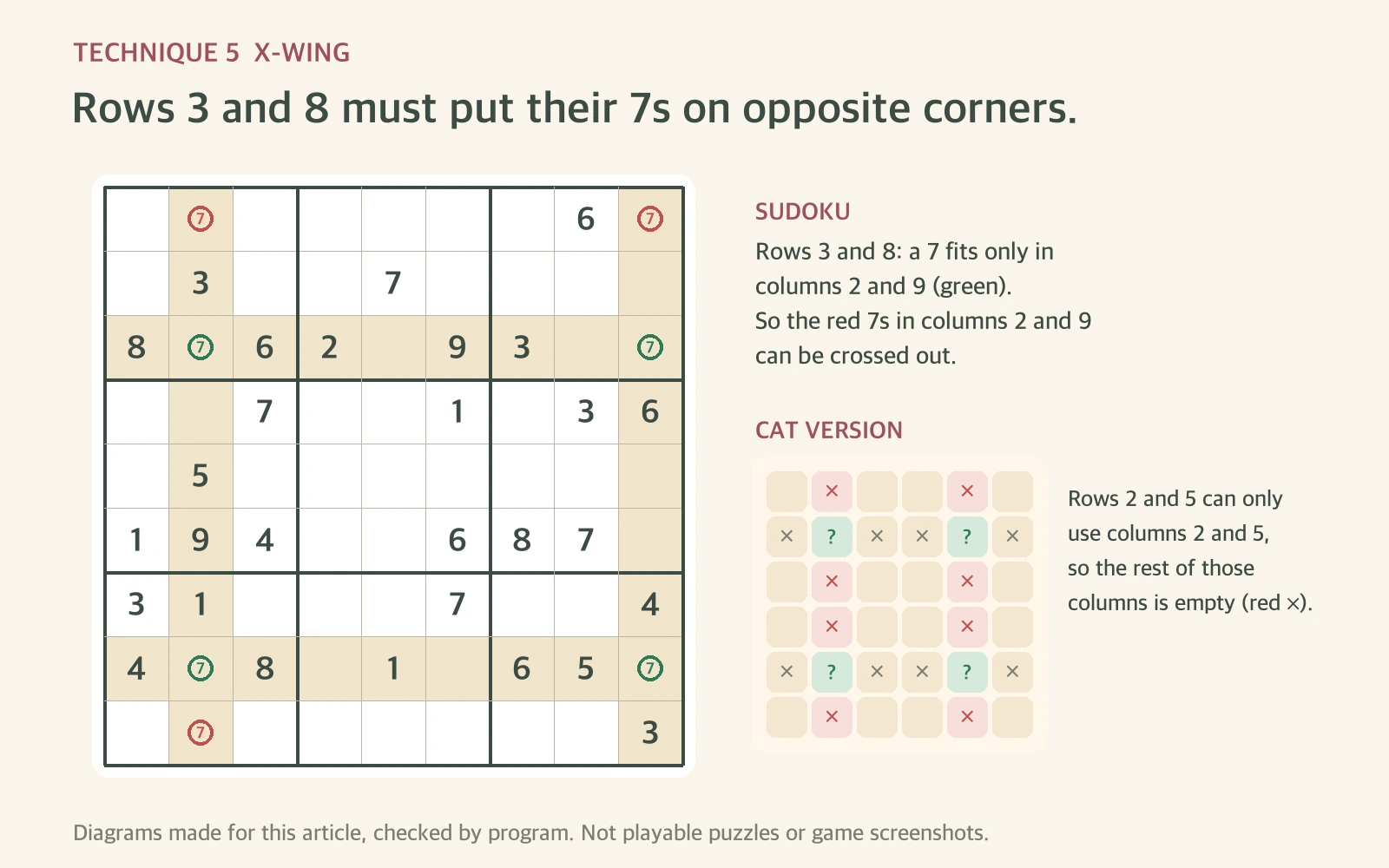
Rows 3 and 8 each need a 7 from columns 2 and 9, so their 7s land on opposite corners and fill both columns. Neither column can have a 7 anywhere else; in our example, that removes three candidate 7s. As SudokuWiki's X-wing page notes, two columns sharing the same two rows work too.
Sudoku strategies when you're stuck
When nothing moves, run this list in order:
- For each number 1 to 9, look for hidden singles in every box, row, and column.
- Erase pencil marks that a new number has ruled out.
- Look for a square with one candidate left.
- Scan each box for a number that sits in only one row or column of it (pointing pair).
- Look for two squares in one line with the same two candidates (naked pair).
- Pick a number and check rows, then columns, for an X-wing.
Missed singles and stale pencil marks are easy to overlook, so repeat steps 1 and 2 before trying anything harder.
The same moves on a cat board
Catdoku uses the same "exactly once" idea with cats instead of numbers. Every row, column, and colored region holds exactly one cat, and cats can't touch, not even diagonally. Three sudoku techniques appear in the app's hints by name:
- Only one spot is the hidden single. When a row, column, or color has one square left for its cat, the cat goes there.
- Locked candidates is the pointing pair. If every possible square for a color's cat is in one row, the rest of that row can be marked empty.
- Reserved groups is the X-wing. If two rows can only use the same two columns, every other square in those columns is empty, like the 6×6 example above.
The no-touching rule adds moves sudoku lacks. Our Queens puzzle strategy guide works through reserved groups on a real Catdoku level, and the jigsaw sudoku guide shows a counting trick that also carries over.
Try it
- In sudoku: look for singles first, keep pencil marks clean, and save pairs and X-wings for when you're stuck.
- The cat version: the free daily puzzle has three new boards every day: Easy 6×6, Normal 8×8, and Hard 9×9.
- More boards: the app has 5,000 levels up to 12×12, and hints that name the move and explain why it works.