
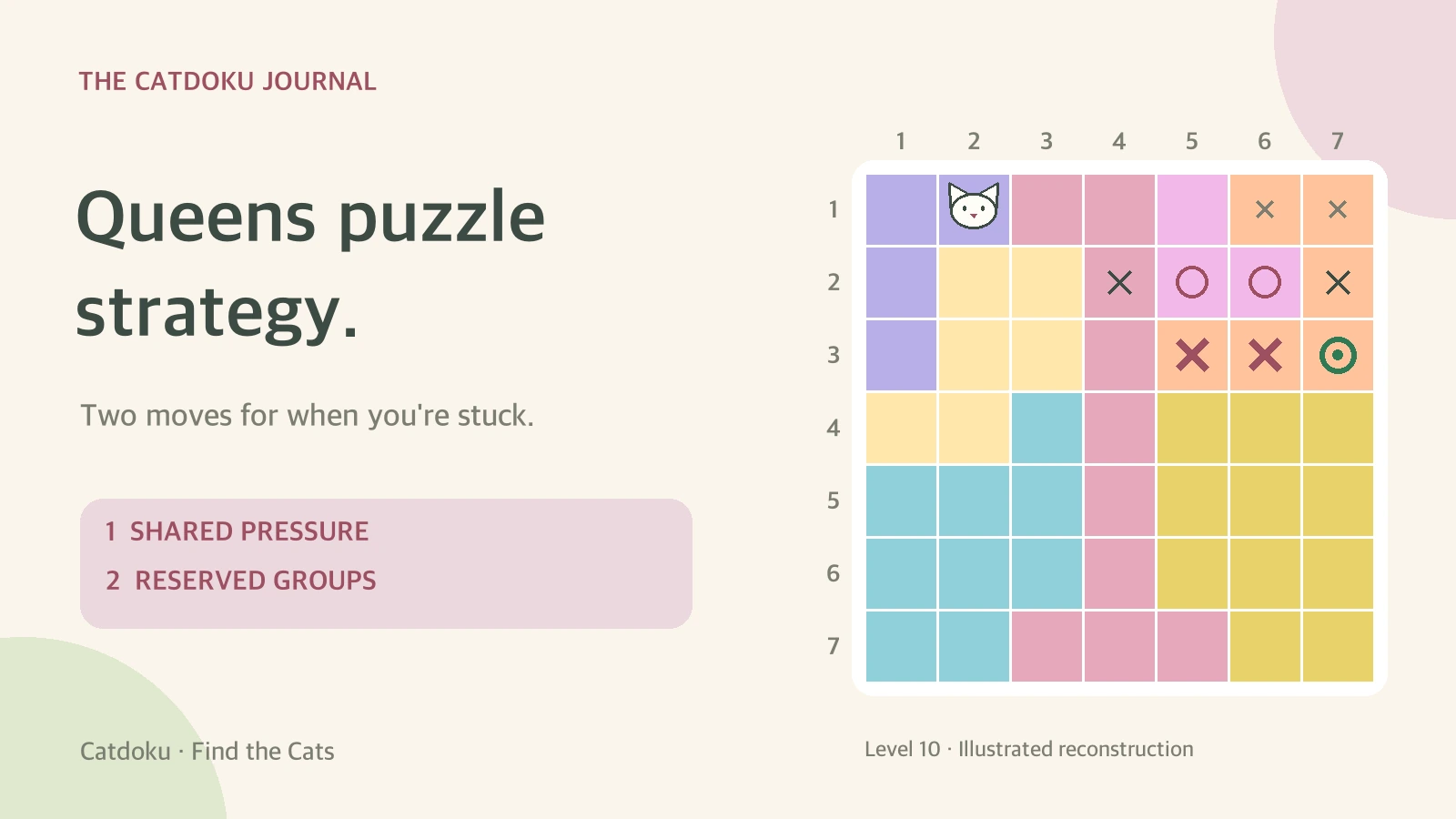
When a Queens-style puzzle stalls, look for squares that every remaining option would block, and for regions squeezed into the same rows or columns. Catdoku's hints call these two ideas shared pressure and reserved groups. They often restart a board after the obvious moves run out.
Catdoku follows Queens-style rules, with cats instead of queens:
- Each row, column, and colored region holds exactly one cat.
- Cats cannot touch, not even diagonally.
If you know Star Battle puzzles, this is the one-star version, so the same ideas carry over. Curious how this differs from the chessboard original? See our guide to the eight queens puzzle.
This guide picks up where our beginner's logic puzzle guide leaves off. That guide covers exclusions around a cat, single candidates, and a region that reserves a whole row. Here we use a harder board: Catdoku Level 10, rated Very Hard in the app.
Practice on today's free Catdoku puzzle →
The board and its starting cat
Rows count from the top and columns from the left, starting at 1, so R1C2 means row 1, column 2. Level 10 is a 7×7 board that begins with one cat at R1C2.
That starting cat clears its row, its column, its purple region, and the squares touching it. After those marks, three regions are already short on space:
- Pink can only use R2C5 or R2C6.
- Pale yellow can only use R3C3 or R4C1.
- Sky can only use R4C3, R5C1, R5C3, R6C1, R6C3, or R7C1.
Both moves below start from this same position.
Move 1: Shared pressure
A region's cat has to go somewhere. If every square it could use would block the same outside square, that outside square is out, whichever option turns out to be right.
The question to ask is: what would each option rule out, and what do they all have in common?
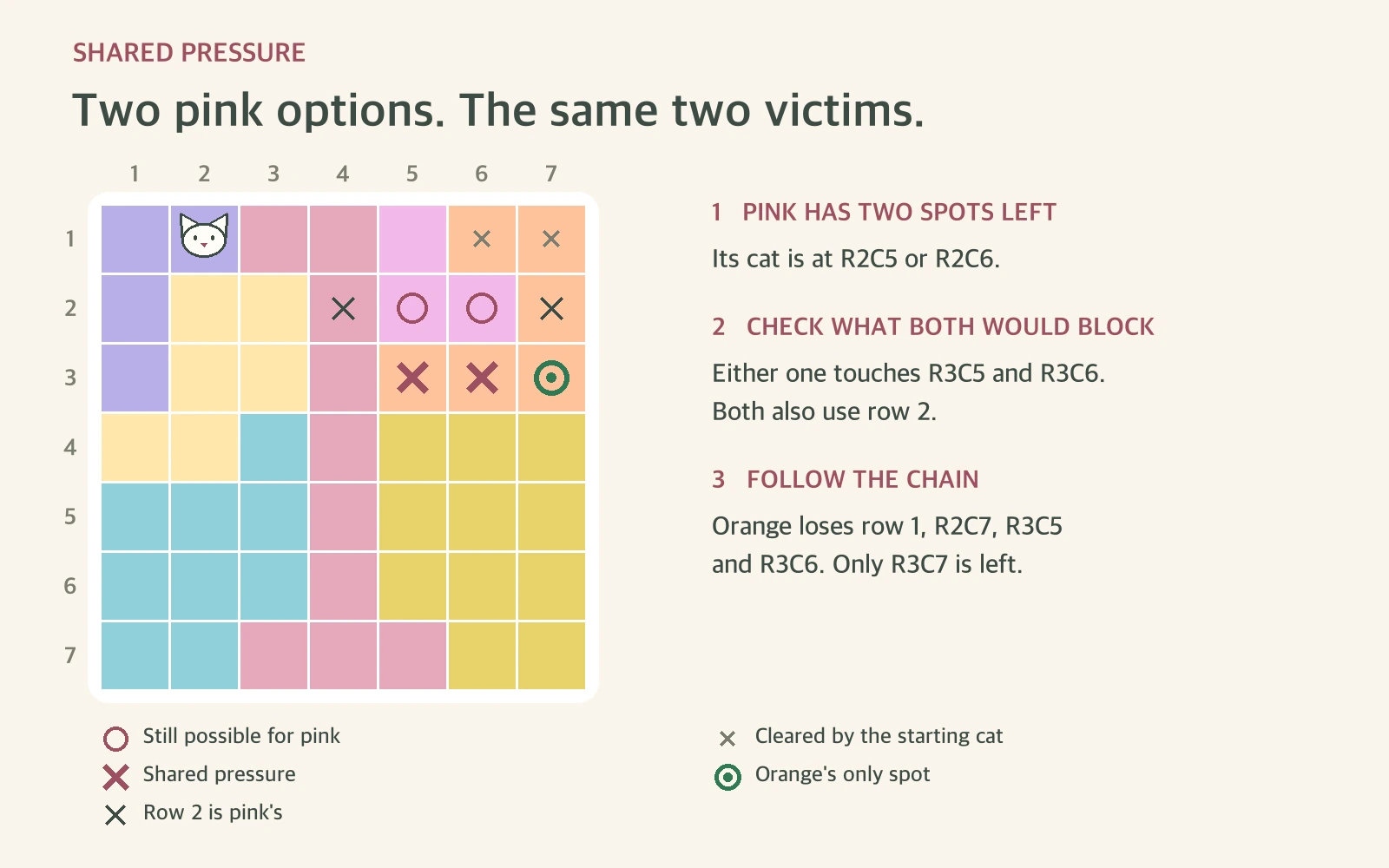
Take the pink region:
- Pink's cat is at R2C5 or R2C6.
- A cat at R2C5 would touch R3C5 (directly below) and R3C6 (diagonally).
- A cat at R2C6 would touch R3C6 (directly below) and R3C5 (diagonally).
- Either way, R3C5 and R3C6 cannot hold cats.
Both pink options also sit in row 2, so pink reserves that row, as in the beginner guide. That rules out R2C4 and R2C7 as well.
Now follow the chain into the orange region. Orange has six squares: R1C6, R1C7, R2C7, R3C5, R3C6, and R3C7. The starting cat already cleared row 1. Pink's reserved row takes R2C7. Shared pressure takes R3C5 and R3C6. Only R3C7 is left, so orange's cat goes there.
That is the pattern to watch for: one move leaves another region with a single square, and a cat can go down.
Shared pressure does not need the options to sit side by side. On the same starting board, pale yellow's two squares are R3C3 and R4C1, far apart. R3C3 touches R4C3 and R4C4, and R4C1 shares row 4 with both. So R4C3 and R4C4 are out too. Different rules can press on the same square.
Move 2: Reserved groups
The beginner guide showed one region confined to a single row. Reserved groups extend that idea: if two regions can only use the same two columns, those two columns belong to them. Each column holds one cat, and those two regions need both. Every other square in those columns can be ruled out. The same works for rows.
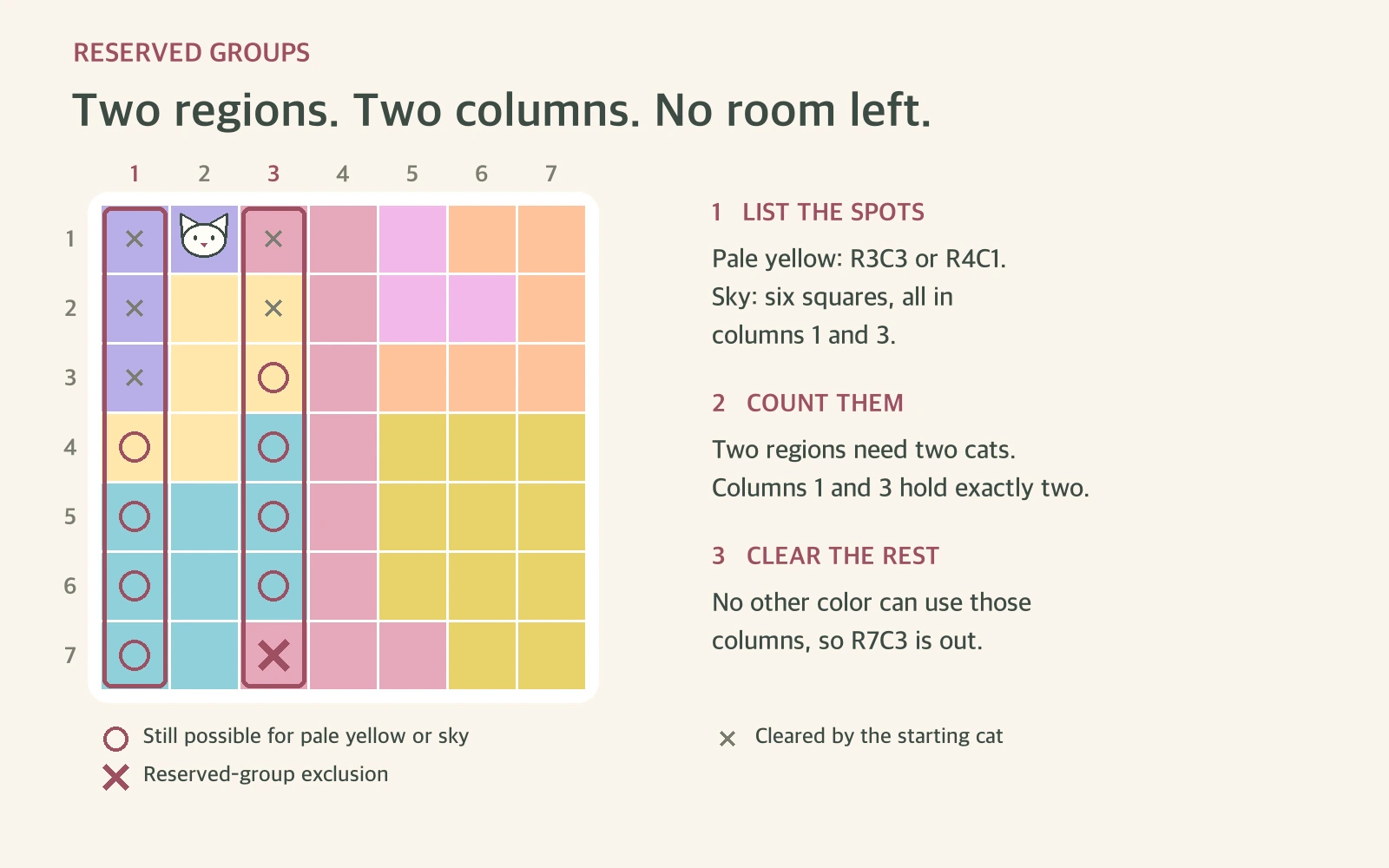
Go back to the starting position and look at pale yellow and sky:
- Pale yellow can use R3C3 or R4C1: columns 1 and 3.
- Sky can use six squares, also only in columns 1 and 3.
- Neither region fits in a single column, so the one-region trick does not apply.
- Together, though, two regions need two cats, and columns 1 and 3 have room for exactly two.
So no other color can place a cat in column 1 or column 3. The starting cat already cleared most of those squares. The new exclusion is R7C3, a rose square at the bottom of column 3.
One square may not look like much. On a board where nothing else moves, one safe mark can be enough to get going again.
The count has to match exactly. Two regions inside two rows or columns works, and so do three regions inside three. If two regions spread across three columns, you learn nothing from this check.
A routine for stuck moments
When a board stalls, work down this list:
- Do the easy checks first. Clear around every cat, look for single candidates, and look for a region locked into one row or column.
- Pick the tightest region. For the region with the fewest options, ask what every option would block.
- Look for pairs. Find two regions that share the same two rows or columns.
- Recheck after each mark. A new exclusion often leaves another region with one square.
Still stuck in the app? Tap the light bulb. The hint explains its reason and highlights the squares involved. When it uses these moves, its title reads Shared pressure or Reserved groups. Read the reason before you apply the marks, and use Undo if you want to retrace a recent mark.
Where to practice
The free daily web puzzle gives you three new boards every day in your browser: Easy 6×6, Normal 8×8, and Hard 9×9. Try spotting shared pressure on the Normal or Hard board.
Level 10 and 5,000 levels up to 12×12 are waiting in the app. New to the rules? Start with our Sudoku alternative guide.