
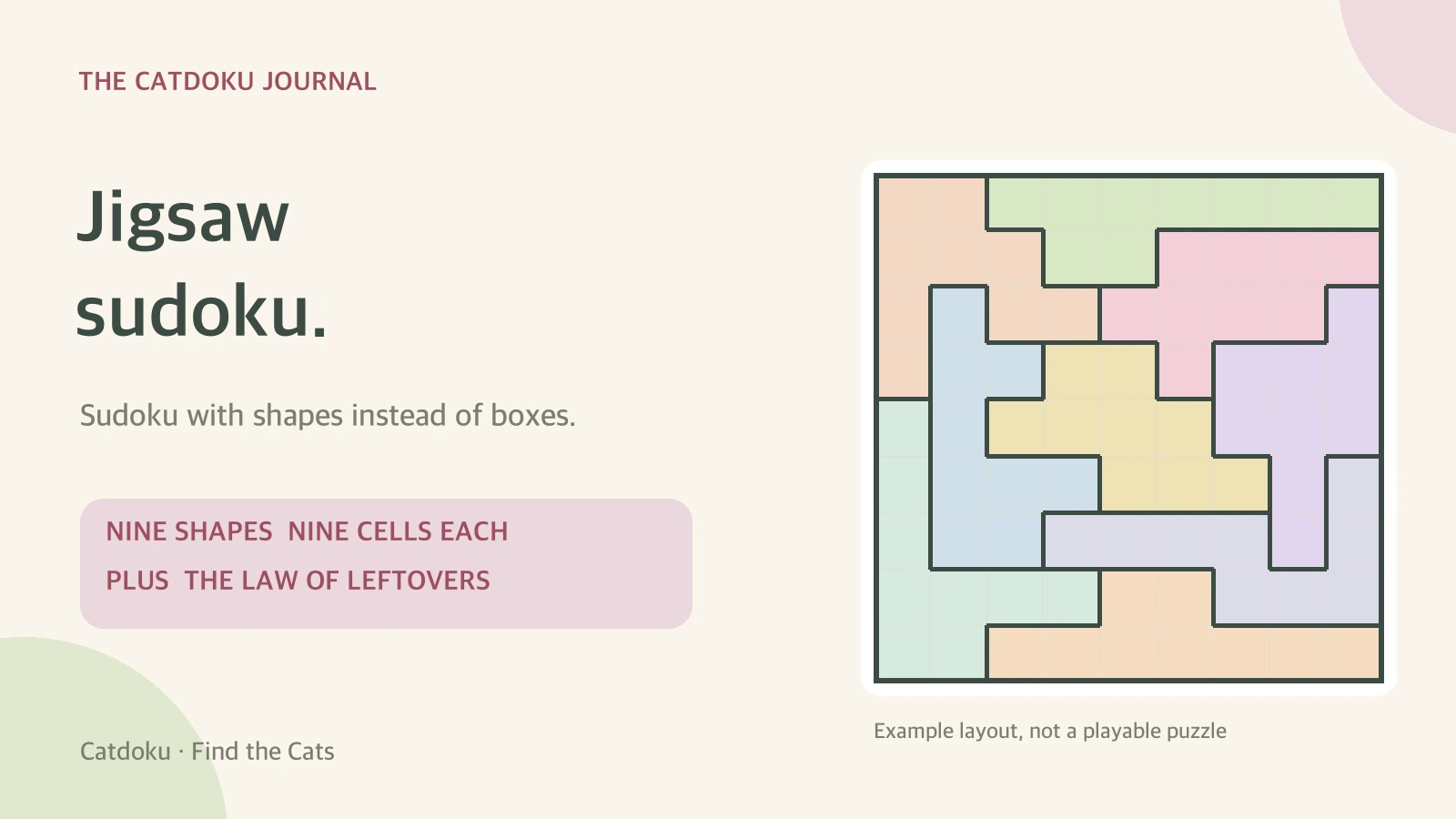
Jigsaw sudoku is sudoku with the nine 3×3 boxes replaced by nine irregular shapes. Each row, each column, and each shape must contain the digits 1 to 9 exactly once. You may also see it called irregular sudoku, or simply sudoku with shapes.
The odd shapes change how the puzzle solves, and they make room for a counting trick called the law of leftovers. Catdoku uses the same idea of irregular regions, with cats instead of digits, and the same counting works there too.
Try today's free cat version →
The rules
A jigsaw sudoku is a 9×9 grid split into nine shapes. Each shape is made of nine connected cells. Then:
- every row contains 1–9 once,
- every column contains 1–9 once, and
- every shape contains 1–9 once.
That is the only change from classic sudoku. The givens and the goal are the same. Another popular variant keeps the boxes and adds the two long diagonals instead: see our diagonal sudoku guide.
What changes when boxes become shapes
In classic sudoku, each box lines up neatly with three rows and three columns. Jigsaw shapes don't. A shape can stretch across four or five rows, or leave a single cell hanging into a neighboring band. Some habits from regular sudoku stop working, since the boxes no longer sit in neat bands of three.
The shapes also give you something new to count. That is where the law of leftovers comes in.
The law of leftovers
Pick some full rows. Then pick the same number of shapes that cover most of those rows. Compare what is left over:
- Innies: cells inside the rows that don't belong to the chosen shapes.
- Outies: cells of the chosen shapes that sit outside the rows.
The innies and the outies always contain the same digits.
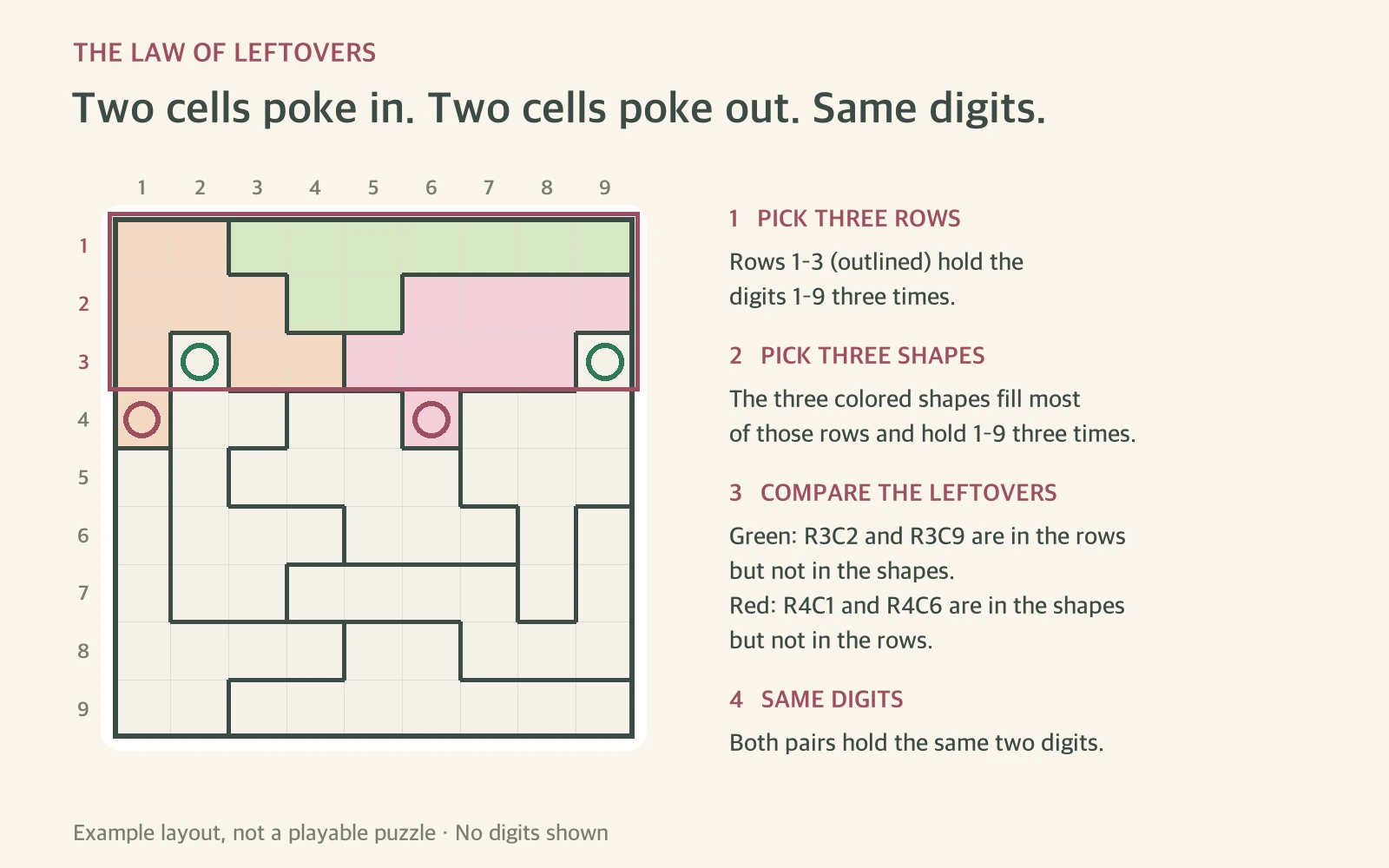
Here is why. Three full rows contain each digit three times. Three full shapes also contain each digit three times. Most cells belong to both groups, so they cancel out. What is left on each side must hold the same digits.
In the example above, rows 1–3 and the three colored shapes leave two innies (R3C2 and R3C9) and two outies (R4C1 and R4C6). The two pairs hold the same two digits, though you don't yet know which digit goes where. We checked this on 25 different completed grids for this layout, and it held every time.
The count has to match: three rows with three shapes, two columns with two shapes, and so on. The same works for columns. It is most useful when only one innie and one outie are left, because then they must be the same digit. Puzzle writers also call it the rule of overlaps.
A cat-shaped cousin
Catdoku uses irregular regions too, but fills them differently.
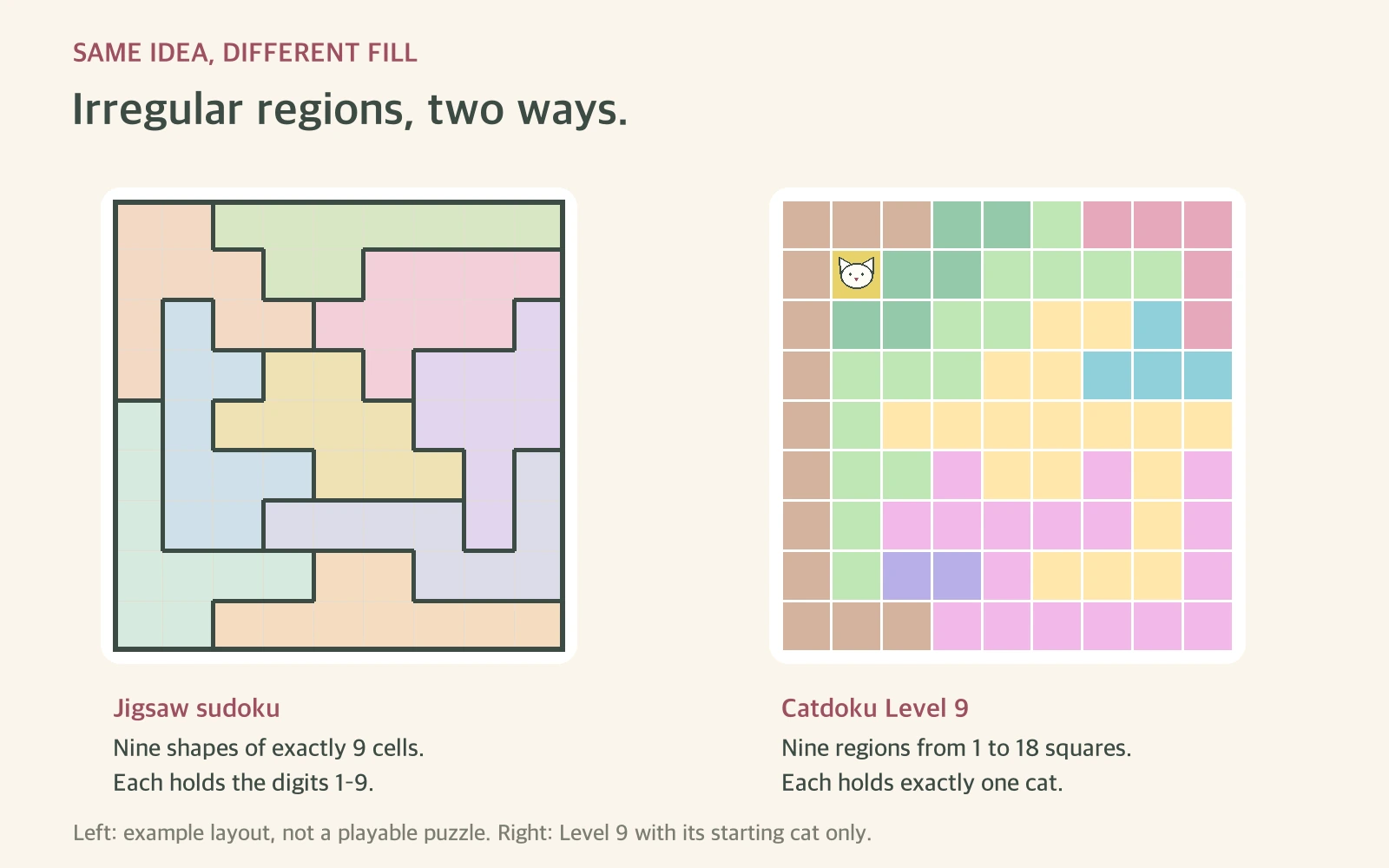
- Jigsaw sudoku: every shape has exactly nine cells and holds every digit.
- Catdoku: regions come in any size and hold exactly one cat. On Level 9, the nine regions range from 1 square to 18.
The other Catdoku rules: each row and each column holds one cat, and cats cannot touch, not even diagonally.
The same counting works with cats
The law of leftovers is really about counting, so it carries over. Pick some rows and the same number of regions:
- the rows hold one cat each,
- the regions hold one cat each,
- so the number of cats in the innies equals the number of cats in the outies.
The most useful case is when the regions don't poke out of the rows at all. Then there are no outies, so the innies can't hold any cats. Every other square in those rows is ruled out.
That is exactly the reserved groups move in our Queens puzzle strategy guide, worked step by step on a real Catdoku board. Our Star Battle guide shows the same counting with two stars per row.
Try it
- Jigsaw sudoku: look for rows or columns whose edges nearly match the shape borders. That is where the law of leftovers pays off.
- The cat version: the free daily puzzle has three new boards every day: Easy 6×6, Normal 8×8, and Hard 9×9.
- More boards: the app has 5,000 levels up to 12×12, and hints that explain their reasoning.