
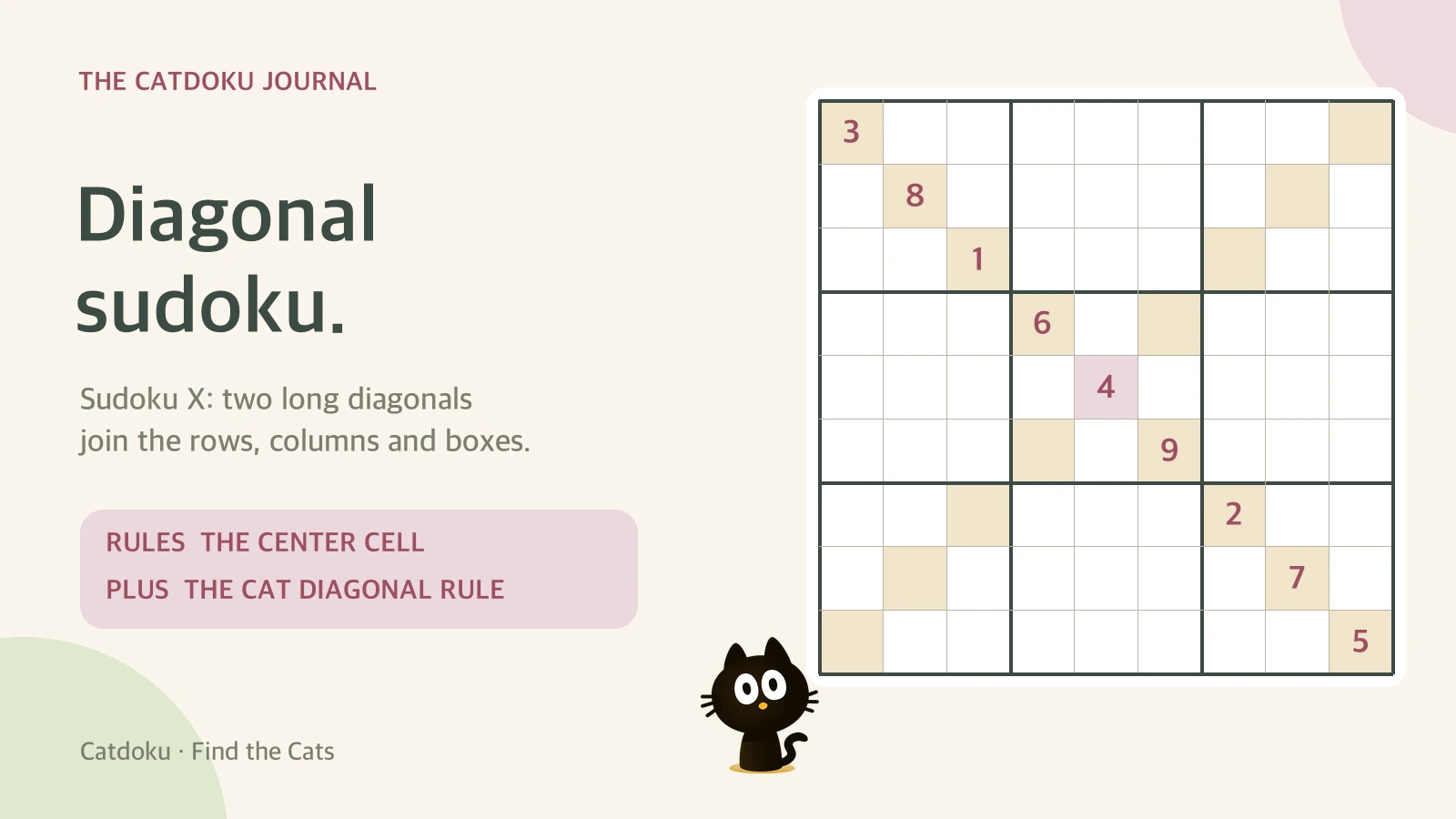
Diagonal sudoku, also called Sudoku X, is sudoku with one extra rule: each of the two long diagonals must also contain the digits 1 to 9 exactly once. Everything else is the same as classic sudoku.
This guide covers the rules, why the center square matters most, how to use the diagonals when you solve, and how Catdoku's own diagonal rule for cats works differently.
Try today's free cat version →
Do diagonals matter in sudoku?
In classic sudoku, no. The rules only cover rows, columns, and the nine 3×3 boxes, so a diagonal can repeat a digit.
In diagonal sudoku, yes. The grid is usually marked with an X or shaded diagonals so you know the extra rule applies. Wikipedia's sudoku article calls unique digits on the main diagonals the most common extra rule in sudoku variants.
The rules of diagonal sudoku
Fill the 9×9 grid with digits 1 to 9 so that each of these holds every digit exactly once:
- each of the 9 rows,
- each of the 9 columns,
- each of the nine 3×3 boxes, and
- each of the two long diagonals, top-left to bottom-right and top-right to bottom-left.
That is 29 groups instead of 27. Puzzle sites such as Puzzlemix state the same rule. Smaller versions exist too: Wikipedia notes 6×6 Sudoku X grids in the Daily Mail.
Why the center cell is special
The center square sits on both diagonals. Count how many other squares each square "sees" (shares a group with):
- Off the diagonals: 20 squares, the same as in classic sudoku (8 in its row, 8 in its column, 4 more in its box).
- On one diagonal: 26 squares. The diagonal adds 6 squares that weren't already in its row, column, or box.
- The center: 32 squares. Both diagonals add 12 new squares between them.
We counted these for every square with a short program. The center is the most constrained square, so check it early.
There is a neat side effect, which SudokuWiki's Sudoku X page points out: any two squares on one diagonal share neither a row nor a column.
How to use the diagonals when solving
SudokuWiki notes that all the normal sudoku strategies still apply. The trick is to treat each diagonal as one more group to scan:
- Scan the diagonals like rows. For each digit missing from a diagonal, check which empty diagonal squares can still hold it.
- Look across, not along. A digit in a square's row, column, or box rules it out.
- Use the other diagonal. The center square also sees the other diagonal, so check both lines there.
- Place the single. If a digit has only one possible square on a diagonal, it goes there.
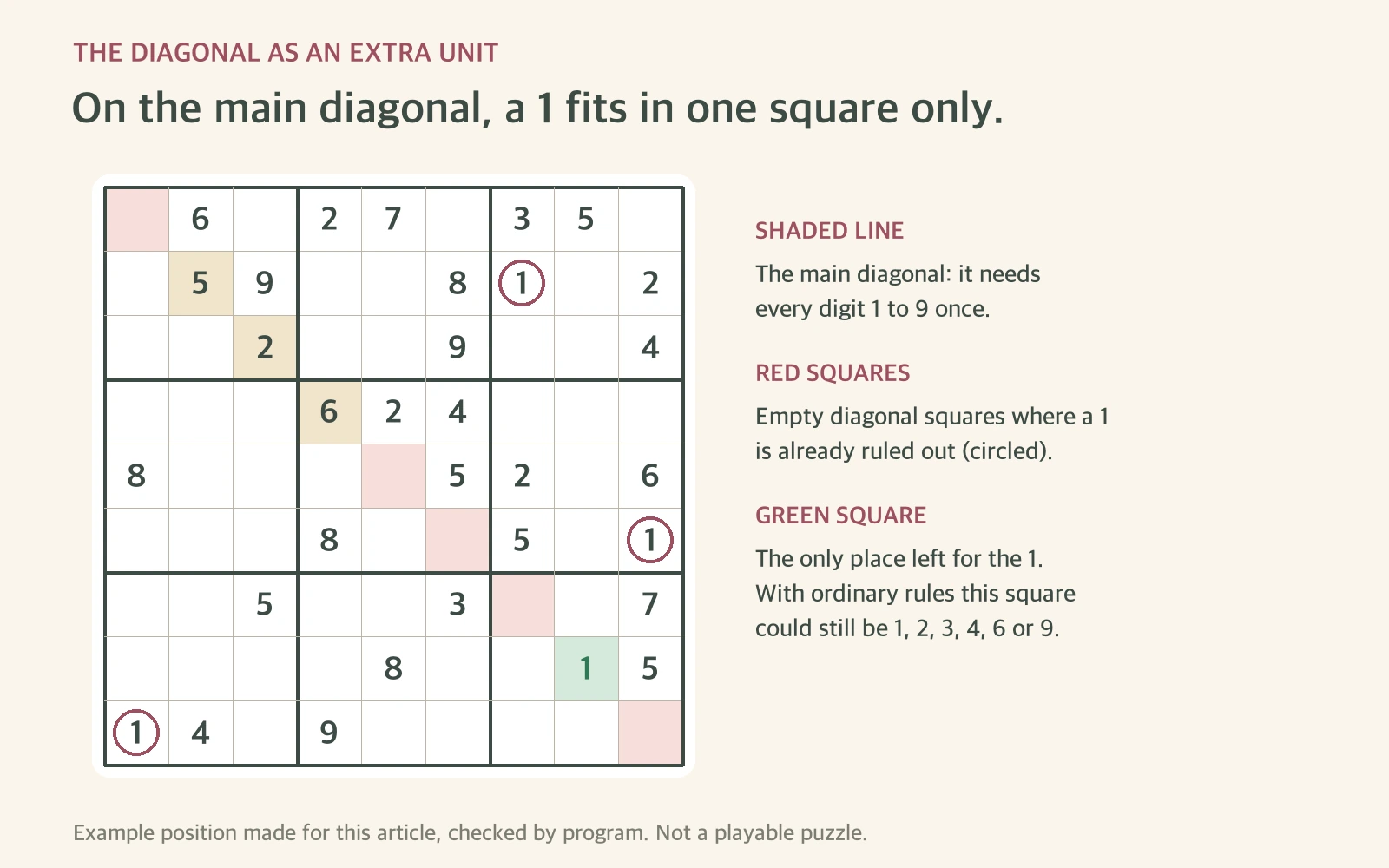
In the example, the main diagonal needs a 1. Four empty diagonal squares can't hold it: the circled 1s cover their rows and columns, and the 1 in the bottom-left corner also sits on the other diagonal, which rules out the center. Only row 8, column 8 is left.
Under classic rules, that 1 is not forced yet. Its row, column, and box each still have two or more places for a 1, and the square itself could still be 1, 2, 3, 4, 6, or 9. The diagonal alone decides it. This is the hidden single again, with a new group to apply it to.
Common mistakes
- Forgetting the second diagonal. It is easy to watch the line you're working on and miss the other one, especially at the center.
- Trusting shortcuts from classic sudoku. SudokuWiki warns that the unique rectangle trick fails when any of its four squares is on a diagonal.
A different diagonal rule: cats that can't touch
Catdoku also has a diagonal rule, but it works on a smaller scale. Every row, column, and colored region holds exactly one cat, and cats cannot touch each other, not even diagonally. The app's tutorial puts it this way: "Every cell around a cat stays empty, diagonals too."
So the cat rule is about neighbors, not whole lines:
- Sudoku X: a digit on a long diagonal rules out that digit for the other 8 squares of the line.
- Catdoku: a cat rules out only the 4 squares that touch its corners. Squares further along the same diagonal are still allowed.
- Chess queens: a queen rules out its whole diagonal, as in the eight queens puzzle.
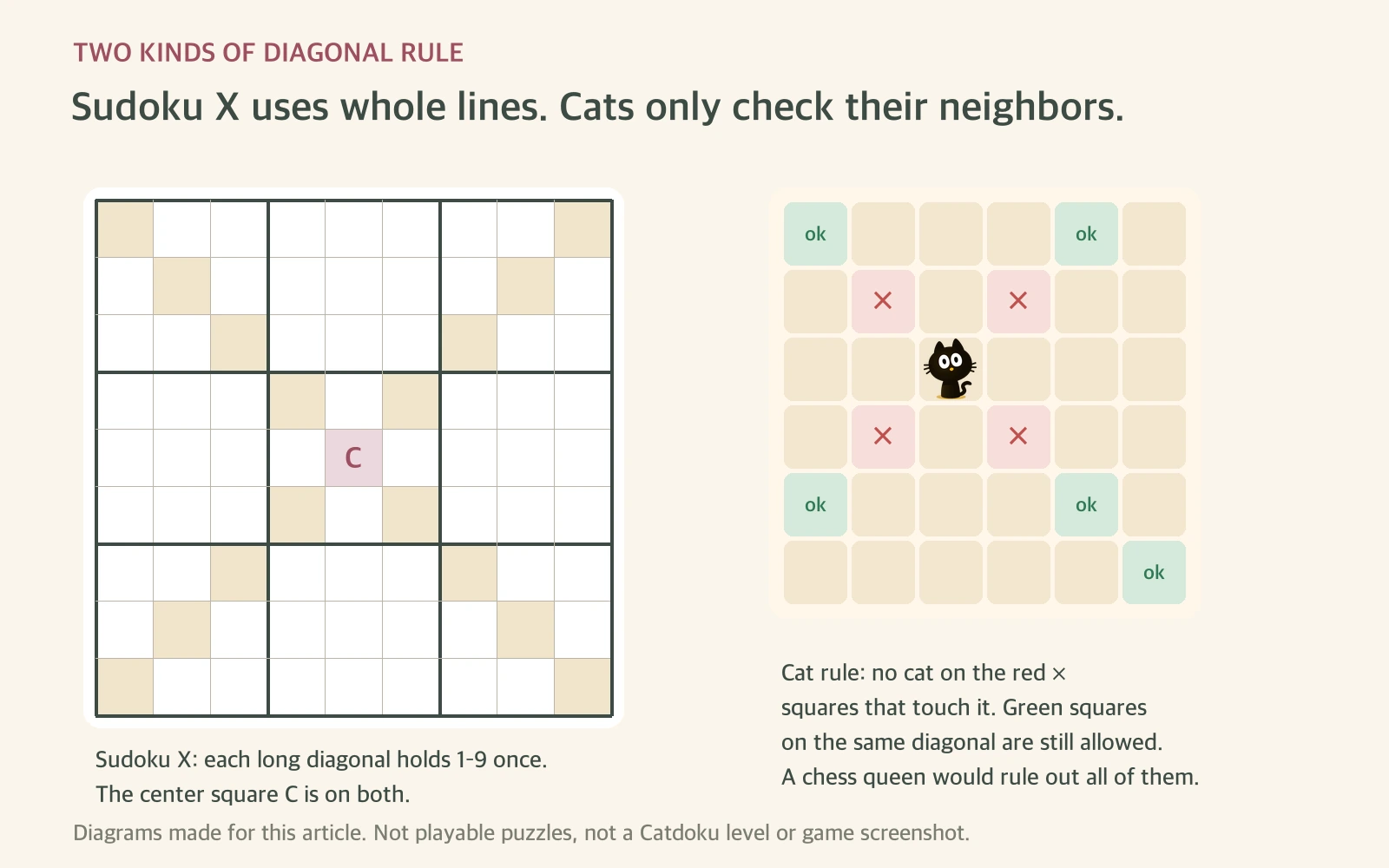
On the 6×6 board, the cat's two diagonals cover 9 other squares. The touching rule removes 4 of them. A queen would remove all 9. The jigsaw sudoku guide shows how irregular regions change the counting.
Try it
- In diagonal sudoku: check the center square first and scan each diagonal like a row.
- The cat version: the free daily puzzle has three new boards every day: Easy 6×6, Normal 8×8, and Hard 9×9.
- More boards: the app has 5,000 levels from 4×4 to 12×12, and hints that explain why each move works.