
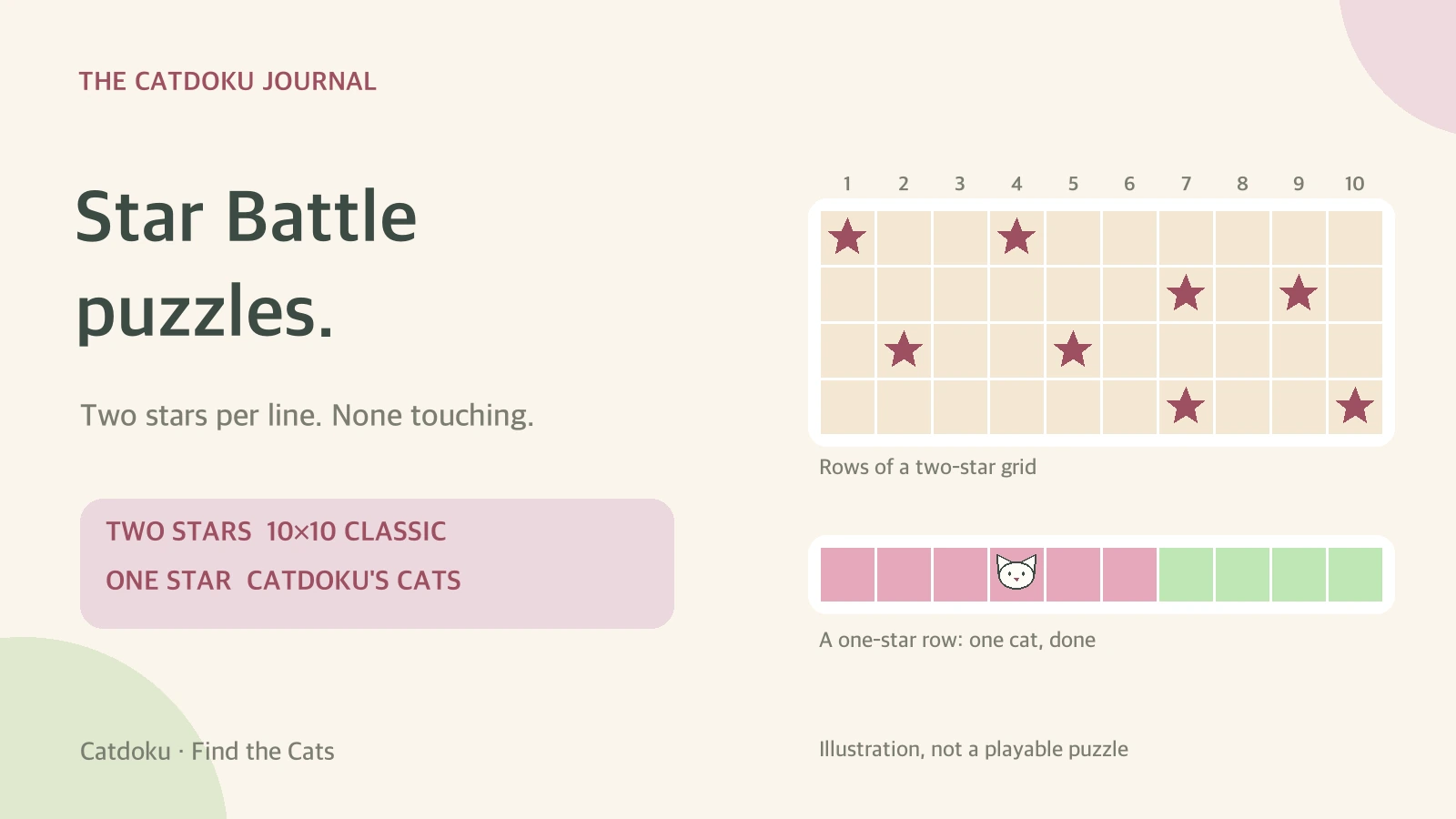
Star Battle is a grid logic puzzle: place stars so that every row, every column, and every outlined region holds the same number of stars, and no two stars touch, not even diagonally. The classic version uses two stars per row, column, and region, often on a 10×10 grid. The genre was created by Hans Eendebak for the 2003 World Puzzle Championship in Arnhem, the Netherlands.
There is also a one-star version, where each row, column, and region holds just one. That is the family Catdoku belongs to, with cats instead of stars. This guide covers the rules, one trick that cracks two-star grids, and how the two versions feel different to solve.
Try today's free one-star puzzle →
The rules
A Star Battle grid is divided into regions with thick borders. The puzzle tells you how many stars go in each row, column, and region, usually 1 or 2. Then:
- every row has exactly that many stars,
- every column has exactly that many stars,
- every region has exactly that many stars, and
- no star touches another star, side or corner.
A well-made puzzle has exactly one solution, and you can reach it by reasoning, without guessing.
One star or two: what changes
The touching rule and the regions work the same way in both versions. The difference is how much a single star tells you.
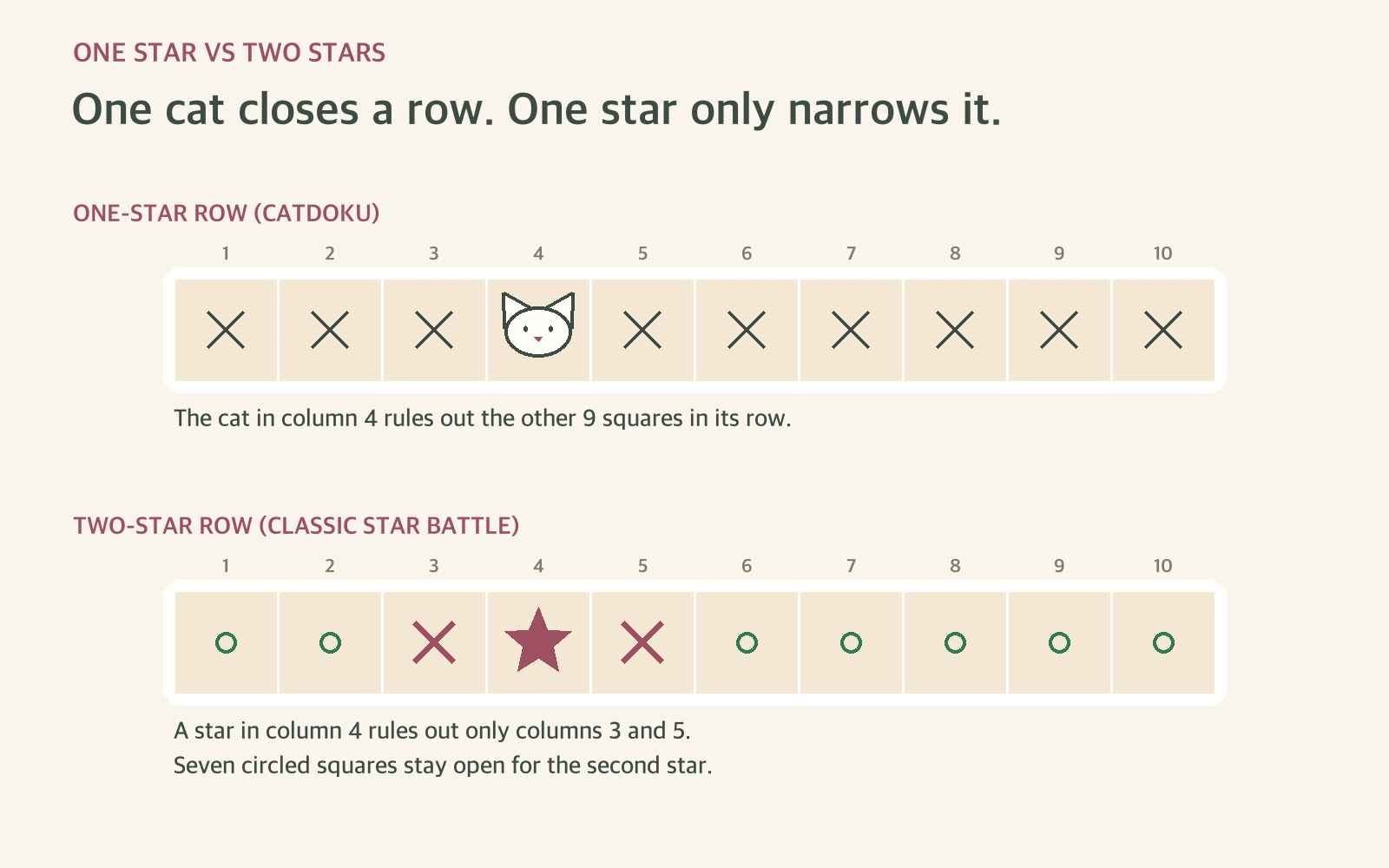
In a one-star puzzle, the moment you place a cat, its whole row, its whole column, and its whole region are finished. In a two-star puzzle, the first star in a row only rules out its two neighbors. The row still needs another star, and seven squares are still open for it.
That is one reason two-star grids are usually larger, and why they reward counting across several rows or regions at once rather than following one placement at a time. One-star boards are a gentler way in: every cat you place settles a lot of the board.
The 2×2 trick
This is the first technique most Star Battle solvers learn, and it comes straight from the touching rule.
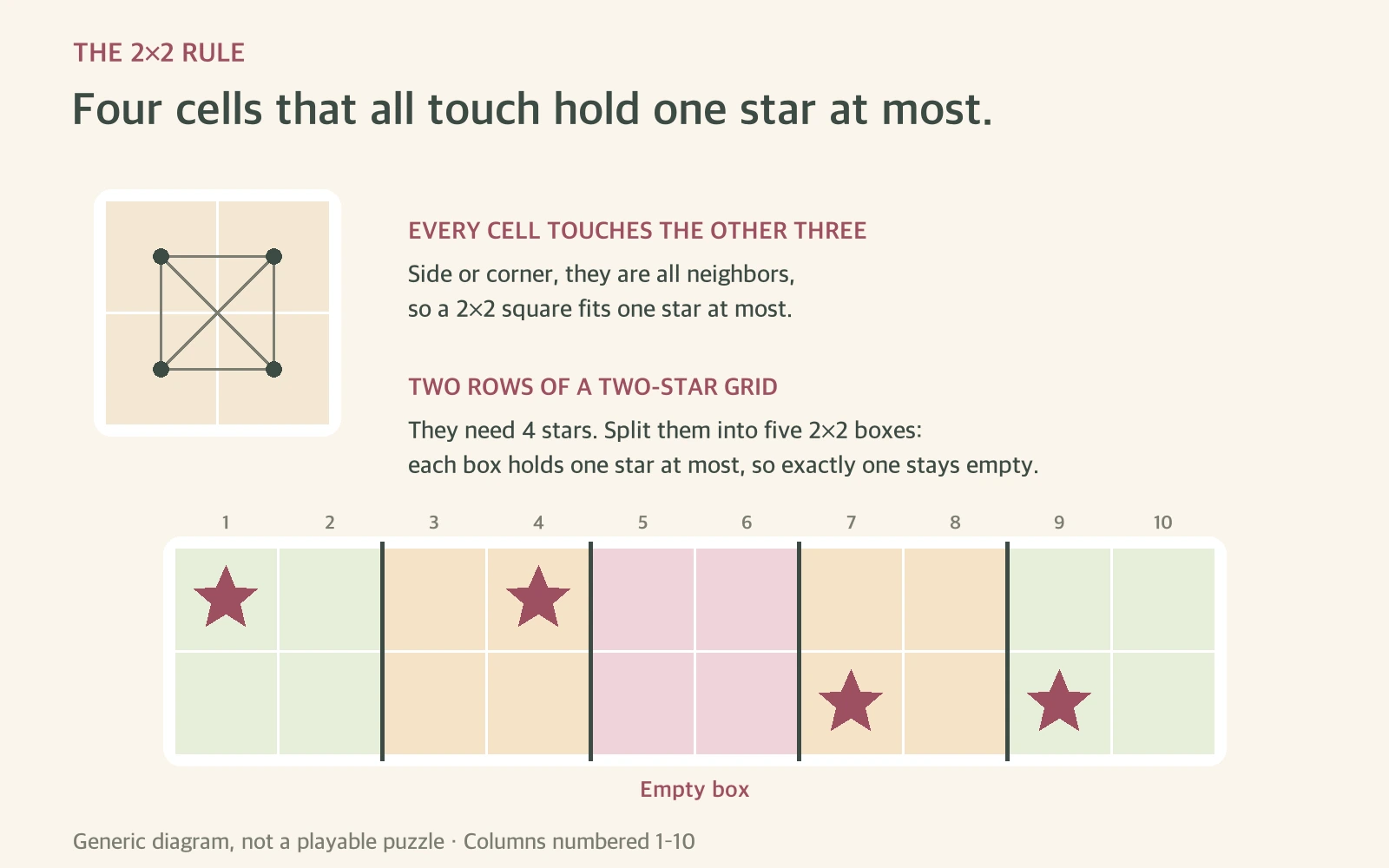
Take any 2×2 square of cells. Every cell in it touches the other three, by a side or a corner. So a 2×2 square can hold at most one star.
Now apply it to a two-star grid that is 10 columns wide:
- Pick two neighboring rows. Together they need 4 stars.
- Split those two rows into five 2×2 boxes: columns 1–2, 3–4, 5–6, 7–8, and 9–10.
- Each box can hold at most one star, and you need 4 stars. So four boxes get one star each, and exactly one box stays empty.
We checked every legal way to fill two such rows (there are 210). Every one leaves exactly one empty box. On a real puzzle, the regions usually tell you which box it has to be, and then each of the other four boxes must hold a star somewhere inside it.
The 2×2 rule works in one-star puzzles too. If all the squares a region could still use fit inside one 2×2 square, its cat will land in that square. Every other cell of that 2×2 square is then out. Our Queens puzzle strategy guide calls this kind of move shared pressure and shows more of it on a real Catdoku board.
Counting regions and rows
Another classic idea scales up from one star to two. If some regions fit entirely inside the same set of rows, they use up those rows' stars:
- One star: two regions inside two rows use both rows' cats.
- Two stars: two regions inside two rows use all four of those rows' stars.
Either way, every other square in those rows is out. The Queens puzzle strategy guide walks through the one-star version, called reserved groups, step by step.
Where Queens-style puzzles fit
A one-star Star Battle is the same puzzle many people now call a Queens-style puzzle: one per row, one per column, one per region, and no touching. Its rules echo the classic chess problem of placing queens that cannot attack each other, and our eight queens puzzle guide explains how that older puzzle differs.
Catdoku uses this one-star version with cats. Boards start small, at 4×4, and grow to 12×12 as you progress. The colored regions do the work that thick borders do in a printed Star Battle.
Try it
- One star, in your browser: the free daily puzzle has three new boards every day: Easy 6×6, Normal 8×8, and Hard 9×9.
- More boards: the app has 5,000 levels and hints that explain their reasoning, including the shared-pressure and reserved-group moves above.
When the one-star boards start to feel quick, a two-star grid is the natural next step. Bring the 2×2 trick with you.