
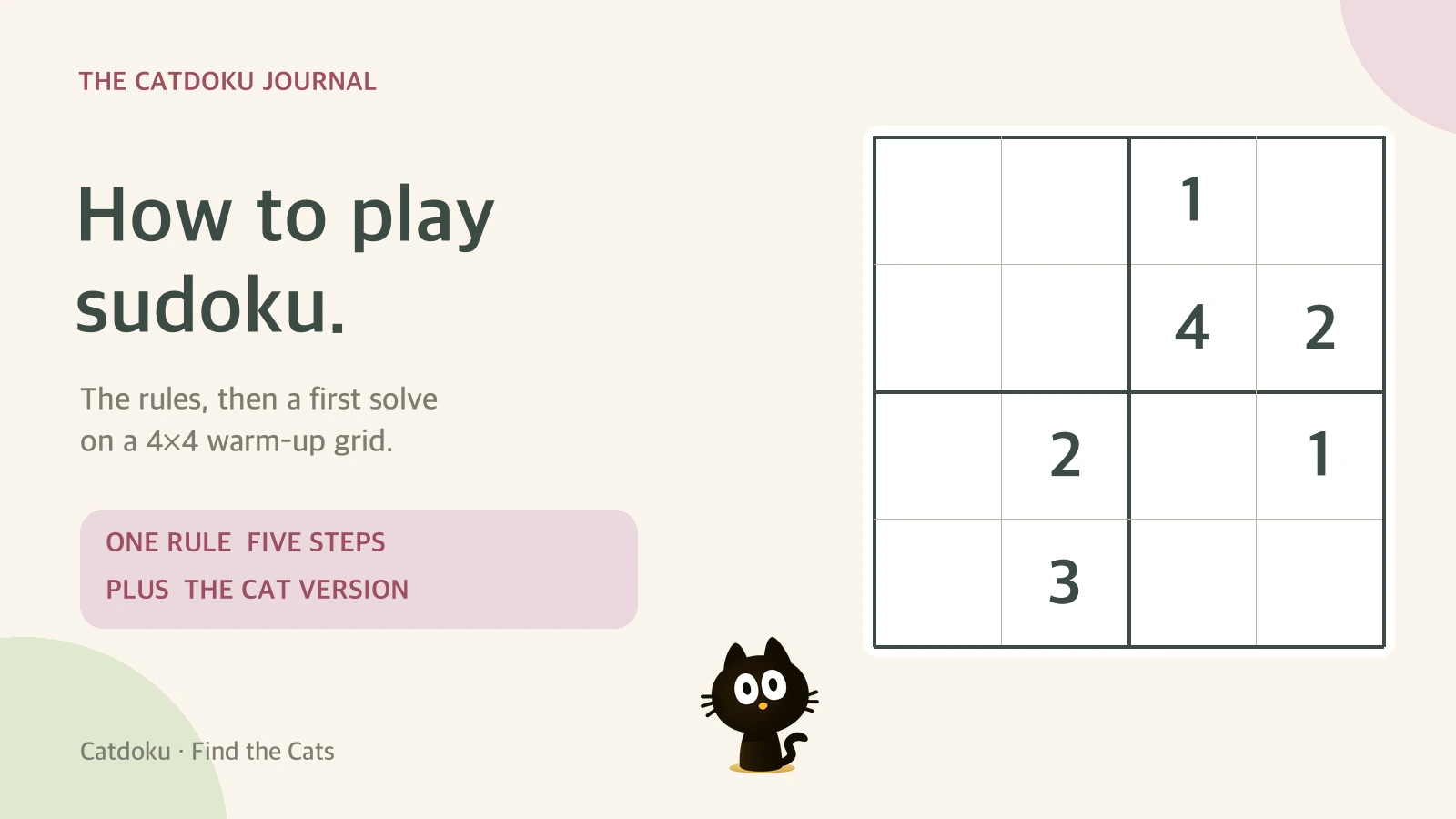
To play sudoku, fill every empty square of a 9×9 grid with a number from 1 to 9 so that each row, each column, and each 3×3 box contains every number exactly once. No math is involved: you only work out which number can still go where.
Below: the rules, a first solve on a 4×4 grid, where to start on a full puzzle, and the cat version.
Try today's free cat version →
Sudoku rules in one minute
Nikoli, the Japanese publisher that named the puzzle, states the rules in two sentences: place a number from 1 to 9 in each empty cell, and each row, column, and 3×3 block contains all the numbers from 1 to 9.
- The grid: 81 squares in 9 rows, 9 columns, and nine 3×3 boxes marked by thick lines.
- The givens: the numbers printed at the start. You never change them.
- The rule: "exactly once." No number repeats in a row, column, or box.
- The answer: a well-made puzzle has one, so logic alone gets you there.
Nikoli also says sudoku "requires no calculations": the digits are just nine symbols. The puzzle first ran in 1979 in Dell magazines as Number Place; Nikoli brought it to Japan in 1984 and shortened the name to sudoku, "su" meaning number and "doku" single (Wikipedia has the longer history).
How to play sudoku step by step: a 4×4 warm-up
The easiest way to learn is a mini sudoku: a 4×4 grid with the numbers 1 to 4 and four 2×2 boxes. Each row, column, and box holds 1, 2, 3, and 4 once.
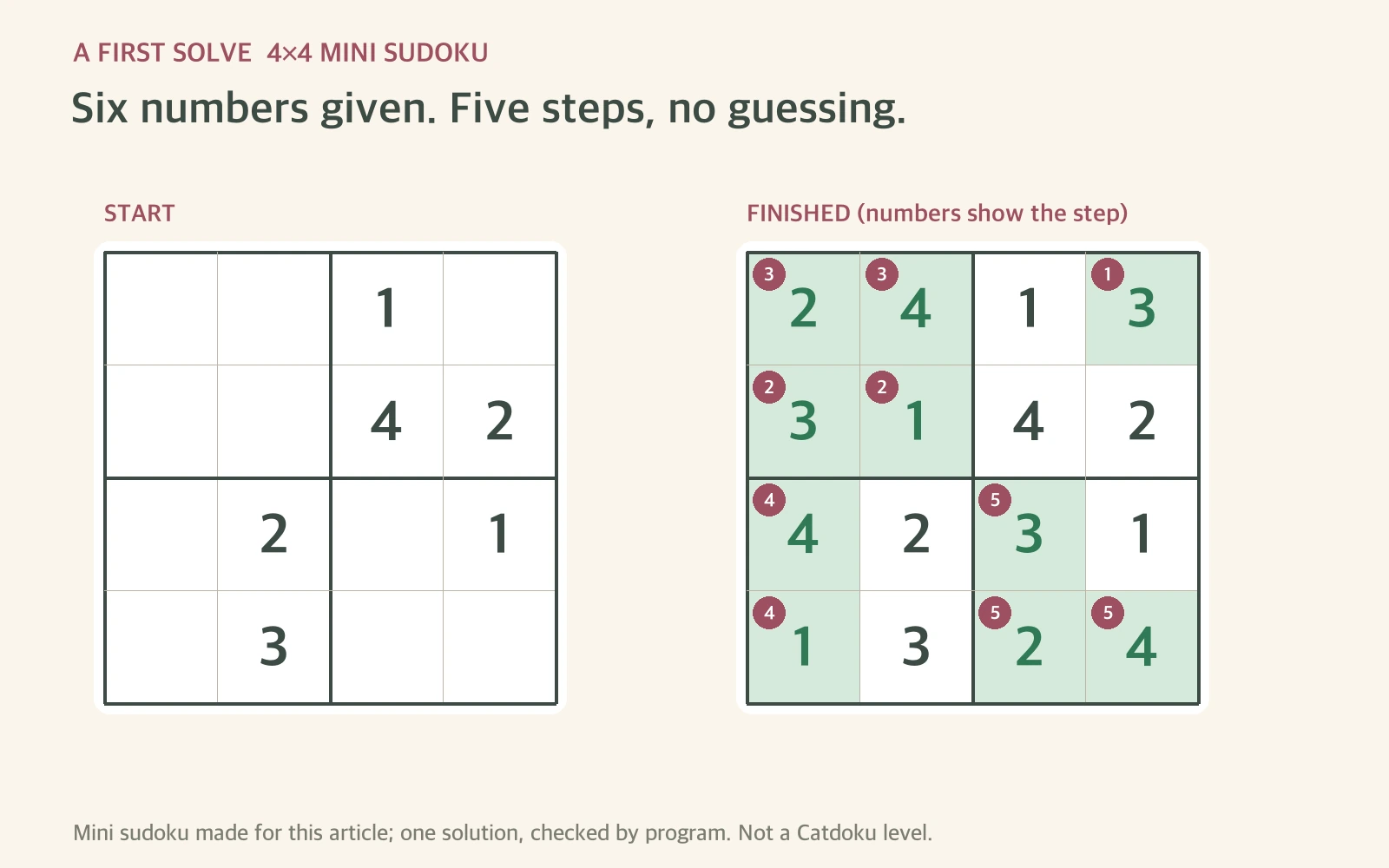
Rows count from the top, columns from the left:
- Finish the nearly full box. The top-right box has 1, 4, and 2, so its last square (row 1, column 4) is 3.
- Use a column to split a pair. Row 2 needs 1 and 3. Column 2 already has a 3, so row 2, column 2 is 1 and row 2, column 1 is 3.
- Repeat on row 1. It needs 2 and 4. Column 2 now holds 1, 2, and 3, so row 1, column 2 is 4 and row 1, column 1 is 2.
- Switch to a column. Column 1 needs 1 and 4. Row 3 already has a 1, so row 3, column 1 is 4 and row 4, column 1 is 1.
- Fill the rest. Row 3 is missing only 3. Row 4 needs 2 and 4; column 3 has a 4, so the 2 goes in column 3 and the 4 in column 4.
Every step asked the same question: which number is missing, and which square can still take it? A small program confirmed the grid has one solution and that each placement was the only possibility at that moment.
Where to start on a 9×9 sudoku
A full puzzle works the same way, with more to scan:
- Pick the number that appears most often among the givens. Fewer places remain for it.
- Scan each box for that number. Every copy in a crossing row or column rules out that line inside the box. If one square is left, write it in.
- Check nearly full lines and boxes. Eight numbers means one answer; seven means a two-way choice, like step 2 above.
- Move to the next number and repeat.
- Add pencil marks when scanning stalls: small notes of what each empty square could still be.
For named techniques such as hidden singles and the X-wing, see our sudoku strategies guide.
Beginner mistakes to avoid
- Forgetting the box. A number can fit its row and column but still repeat in its box.
- Guessing. A wrong guess can break the grid many moves later. If nothing is forced, look again.
- Writing in pen too early. Use pencil or an app with undo.
- Starting too hard. Easy puzzles give more numbers; 4×4 and 6×6 grids are good practice.
Is cat sudoku played the same way?
Catdoku (Find the Cats - Cat Sudoku! in app stores) keeps "exactly once" but swaps numbers for cats:
- Every row, column, and colored region holds exactly one cat.
- Cats can't touch each other, not even diagonally.
- Each board has one solution.
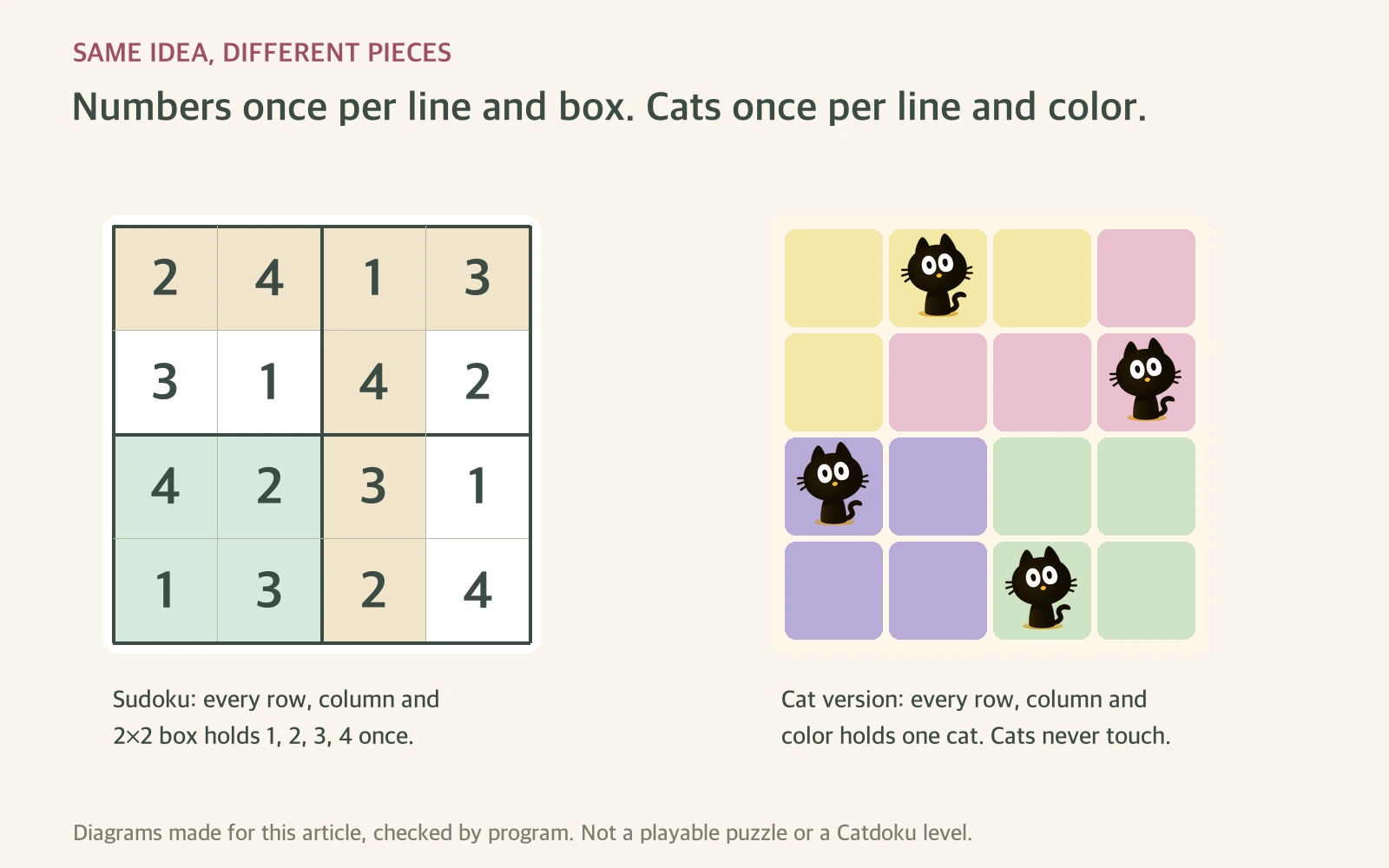
The no-touching rule makes small boards tight: we counted every arrangement, and a 4×4 grid has only two ways to place one cat per row and column with no two touching. The colors pick one.
The habit carries over. Sudoku asks "where can this 5 go?"; Catdoku asks "where can this region's cat go?" In the app, one tap marks a square as empty and two quick taps place a cat, and hints such as "Only one spot" explain the move. Our guide to how to solve logic puzzles shows the routine on a real board.
Try it
- Sudoku: start small, scan one number at a time, and never guess.
- The cat version: the free daily puzzle has three new boards every day: Easy 6×6, Normal 8×8, and Hard 9×9.
- More boards: the app has 5,000 levels from 4×4 up to 12×12, with hints that explain each move.