
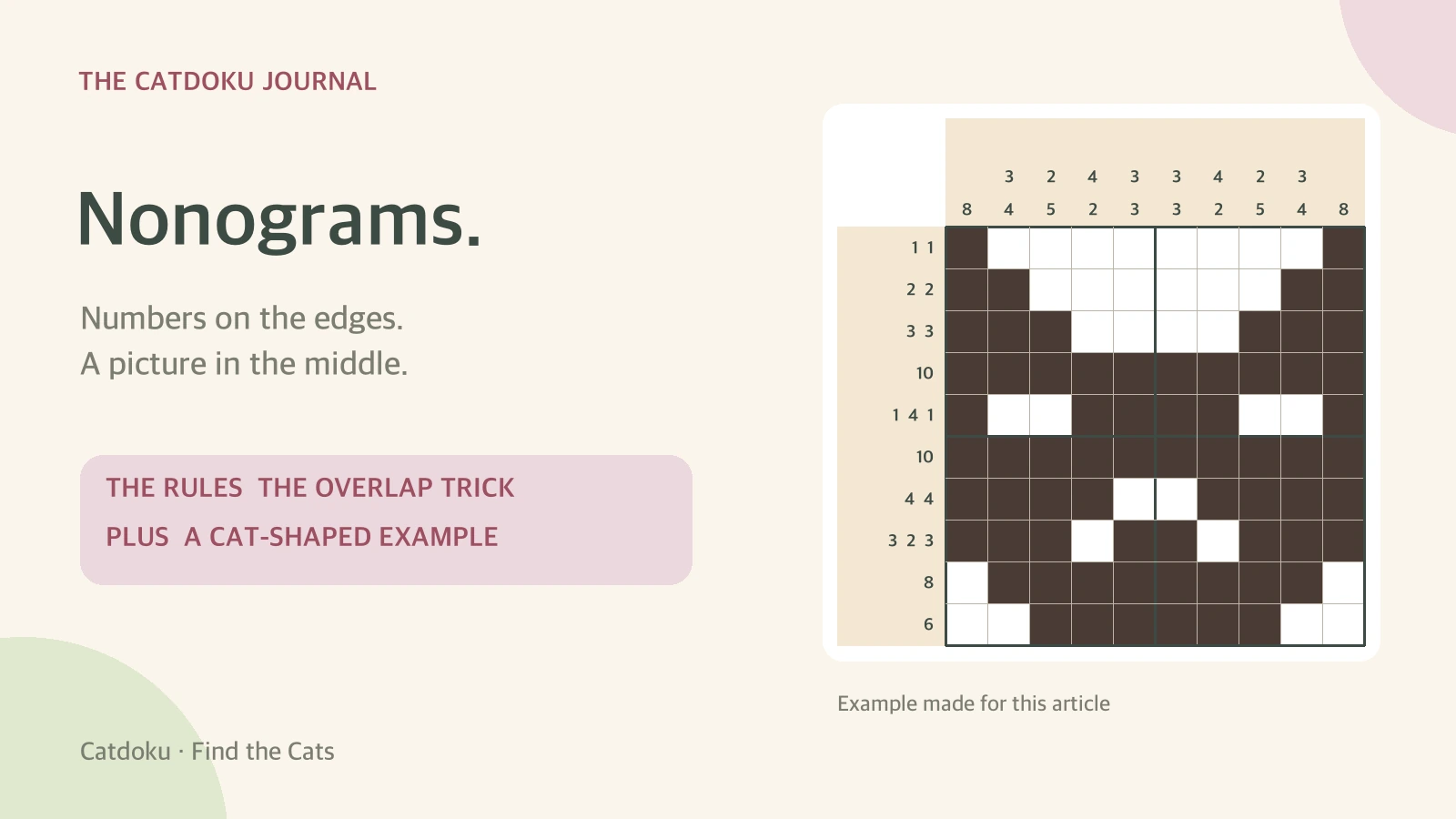
A nonogram is a picture logic puzzle: the numbers beside each row and above each column tell you which squares to fill, and the filled squares reveal a hidden picture. You may know it as Picross, Griddlers, Hanjie, or paint by numbers.
This guide covers the rules, the overlap trick that starts almost every nonogram, and what these puzzles share with Catdoku's cat boards.
Try today's free cat version →
The rules
A nonogram is a grid of blank squares with a clue for every row and every column.
- Each number in a clue is one unbroken run of filled squares.
- The runs appear in the same order as the numbers: left to right for rows, top to bottom for columns.
- Between two runs in the same line there is at least one blank square.
- The puzzle is solved when every row and every column matches its clue.
So a row clue of 1 4 1 means: one filled square, then a gap, then four filled squares, then a gap, then one more. The clue does not say where the runs start. Working that out is the puzzle.
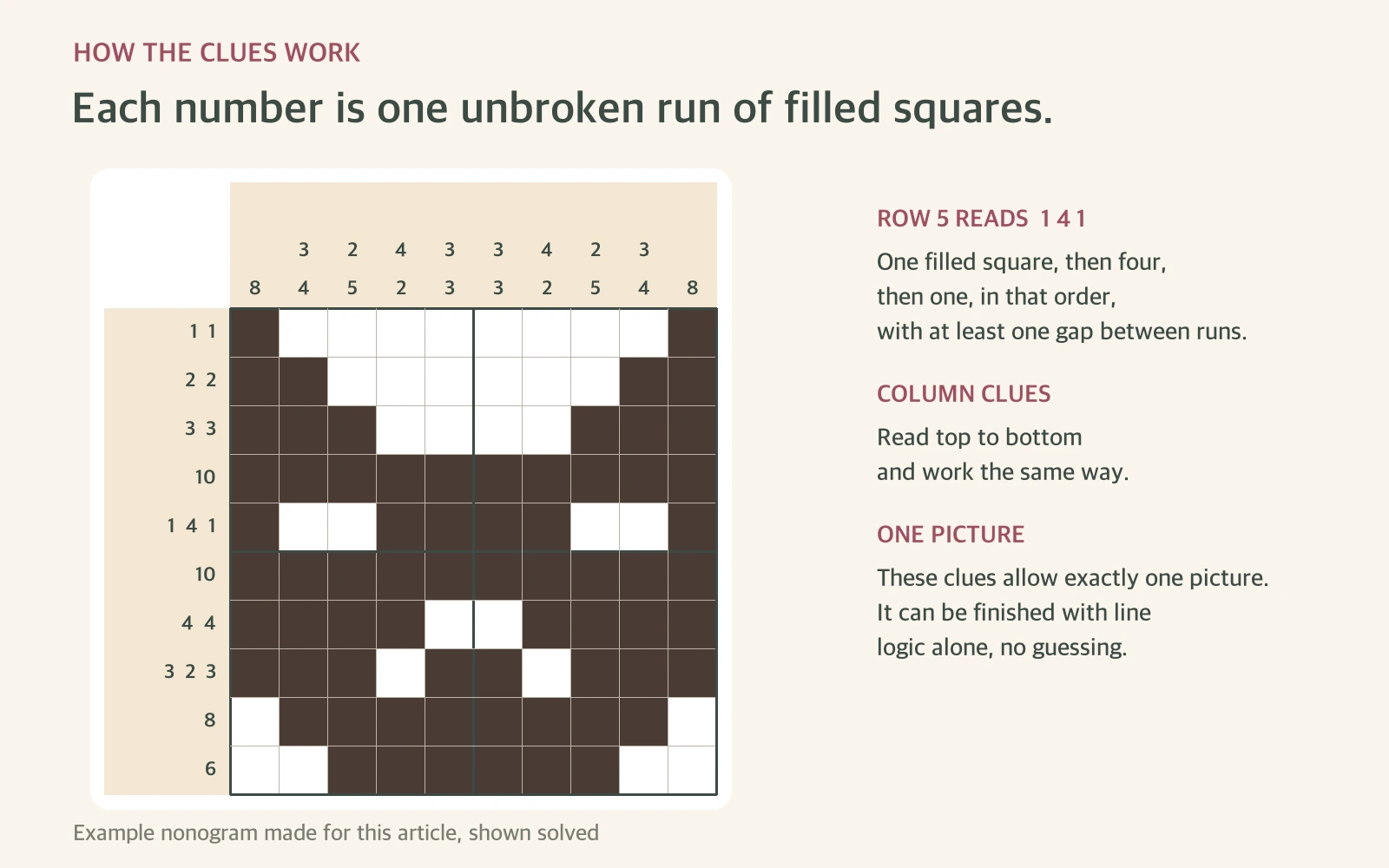
We made this 10×10 cat face for the article and checked it with a small program: its clues allow exactly one picture, and you can finish it with line-by-line logic alone, without guessing.
Where nonograms come from
According to the Puzzle Museum's history of picture grid puzzles, Japanese graphics editor Non Ishida won a 1987 competition in Tokyo with a picture made by switching skyscraper lights on and off. That gave her the idea for a puzzle built from filled squares, and in 1988 she published three "Window Art Puzzles." Tetsuya Nishio published the same kind of puzzle independently at about the same time.
In 1990, puzzle collector James Dalgety named them nonograms, from "Non" and "diagram," and The Sunday Telegraph began printing one every week. In 1998, the paper's readers voted for a new name: Griddlers. Picross is the name Nintendo uses for its nonogram games.
How to solve nonograms: start with the overlap trick
Take a row of 10 squares with the clue 7. The run could start in square 1, 2, 3, or 4. Push it all the way left and it covers squares 1–7. Push it all the way right and it covers squares 4–10.
Squares 4–7 are filled in every possible position, so you can fill them now.
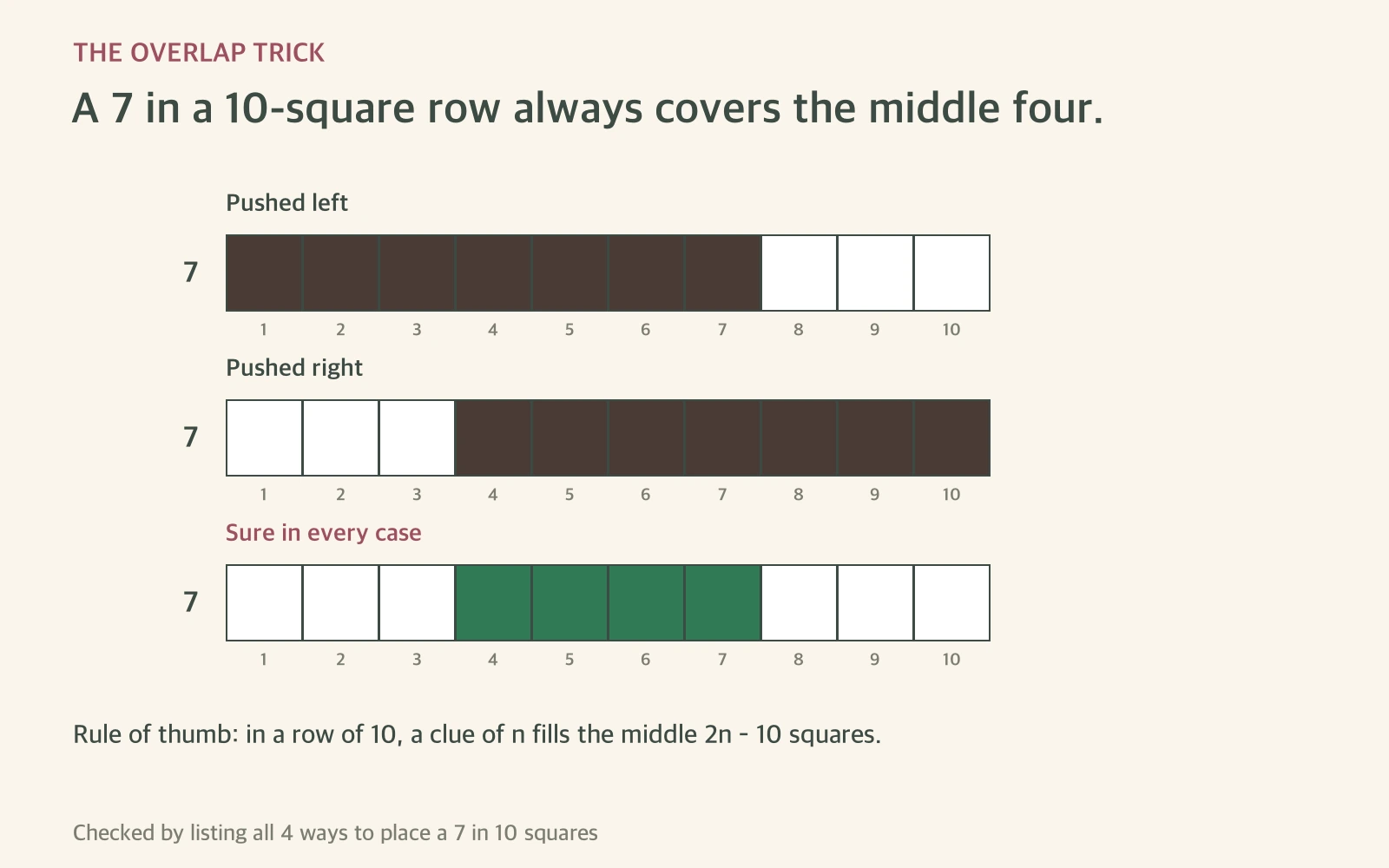
A quick rule for a single number: in a row of 10, a clue of n always fills the middle 2n − 10 squares. A 6 gives you two squares, an 8 gives you six, and a 5 or less gives you none yet.
The same pushing works with several numbers. For 3 4 in a row of 10, pushing everything left and everything right shows that squares 3, 7, and 8 must be filled. And when the numbers plus the gaps between them add up to the whole row, the row is already solved. In the cat example, row 8 reads 3 2 3: 3 + 2 + 3 plus two gaps is exactly 10.
Mark the empty squares too
An empty square you can prove is worth as much as a filled one. Most nonogram apps let you mark it with an X or a dot.
Then switch direction. Every square you settle in a row is new information for its column, and the other way around. In the cat example:
- Rows 4 and 6 have the clue 10, so they fill completely.
- Row 8 (3 2 3) fits only one way.
- Columns 1 and 10 have the clue 8, so the overlap trick fills rows 3–8 in both.
- Each new square shrinks the options in its crossing line, and the face appears one line at a time.
The same row-and-column back-and-forth drives binary puzzles (takuzu), where every square is a 0 or a 1 and counting does most of the work.
Nonograms and Catdoku
Catdoku looks different, with colored regions and cats instead of numbers, but the work feels familiar. You decide square by square whether something belongs there, and you mark the squares that can't hold anything. In the Catdoku app, one tap marks a square as empty and two quick taps place a cat.
The difference is the clue. In a nonogram, every line has its own numbers. In Catdoku, the rule is the same everywhere:
- every row and every column holds exactly one cat,
- every colored region holds exactly one cat, and
- cats cannot touch, not even diagonally.
In nonogram terms, every row and column of a Catdoku board has the clue 1. The regions and the no-touching rule do the rest.
The overlap trick has a cat version too. If every square where a region's cat could go sits in one row, that row is reserved for the region, and you can mark the rest of the row as empty. Our logic puzzle strategy guide works through that move on a real board, and our Queens puzzle strategy guide adds two harder ones.
Try it
- Nonograms: start with the biggest clues and with lines whose numbers and gaps nearly fill the row. Mark every square you rule out.
- The cat version: the free daily puzzle has three new boards every day: Easy 6×6, Normal 8×8, and Hard 9×9.
- More boards: the app has 5,000 levels up to 12×12, and hints that explain their reasoning.