
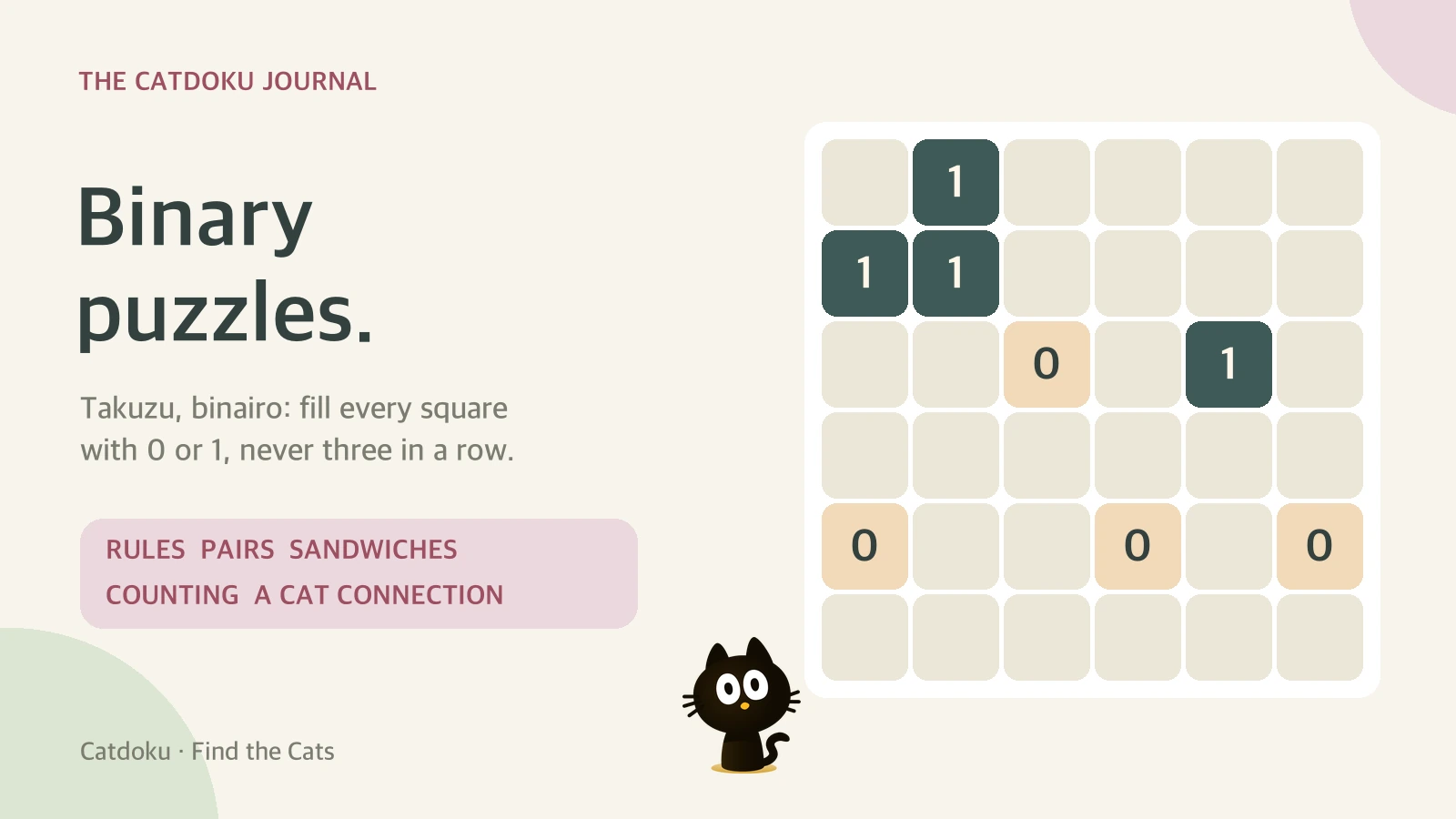
A binary puzzle is a grid you fill with 0s and 1s so that every row and column has the same number of each, no three equal digits sit next to each other in a line, and no two rows or columns are identical. It is also sold as takuzu, binairo, and several other names.
This guide covers the rules, three moves that need no guessing, a small puzzle to try, and how a Catdoku board compares.
Try today's free cat version →
What are the rules of a binary puzzle?
Most binary puzzles use these four rules. The wording below follows binarypuzzle.com and Puzzle Binairo:
- Each square holds a 0 or a 1.
- No more than two equal digits sit side by side in a row or column. So 0 0 is fine, 0 0 0 is not.
- Each row and each column has as many 0s as 1s. On a 6×6 grid, that means three of each.
- No two rows are the same, and no two columns are the same.
Some versions use black and white circles instead of 1 and 0. The logic is the same.
Takuzu, binairo, binary sudoku: one puzzle, many names
According to Wikipedia's takuzu article, the puzzle also appears as Binairo, Binero, Tohu-Wa-Vohu, Binoxxo, Tic-Tac-Logic, and Sudoku Binary. The same article says Binairo was created by Peter De Schepper and Frank Coussement of Belgium in 2009, and that Tohu wa Vohu was invented by Adolfo Zanellati of Italy.
"Binary sudoku" usually means this same puzzle. Despite the name, it has no 3×3 boxes and no arithmetic.
How to solve binary puzzles: three moves
You can solve most binary puzzles with three moves. Each one follows from the rules, so none of them is a guess.
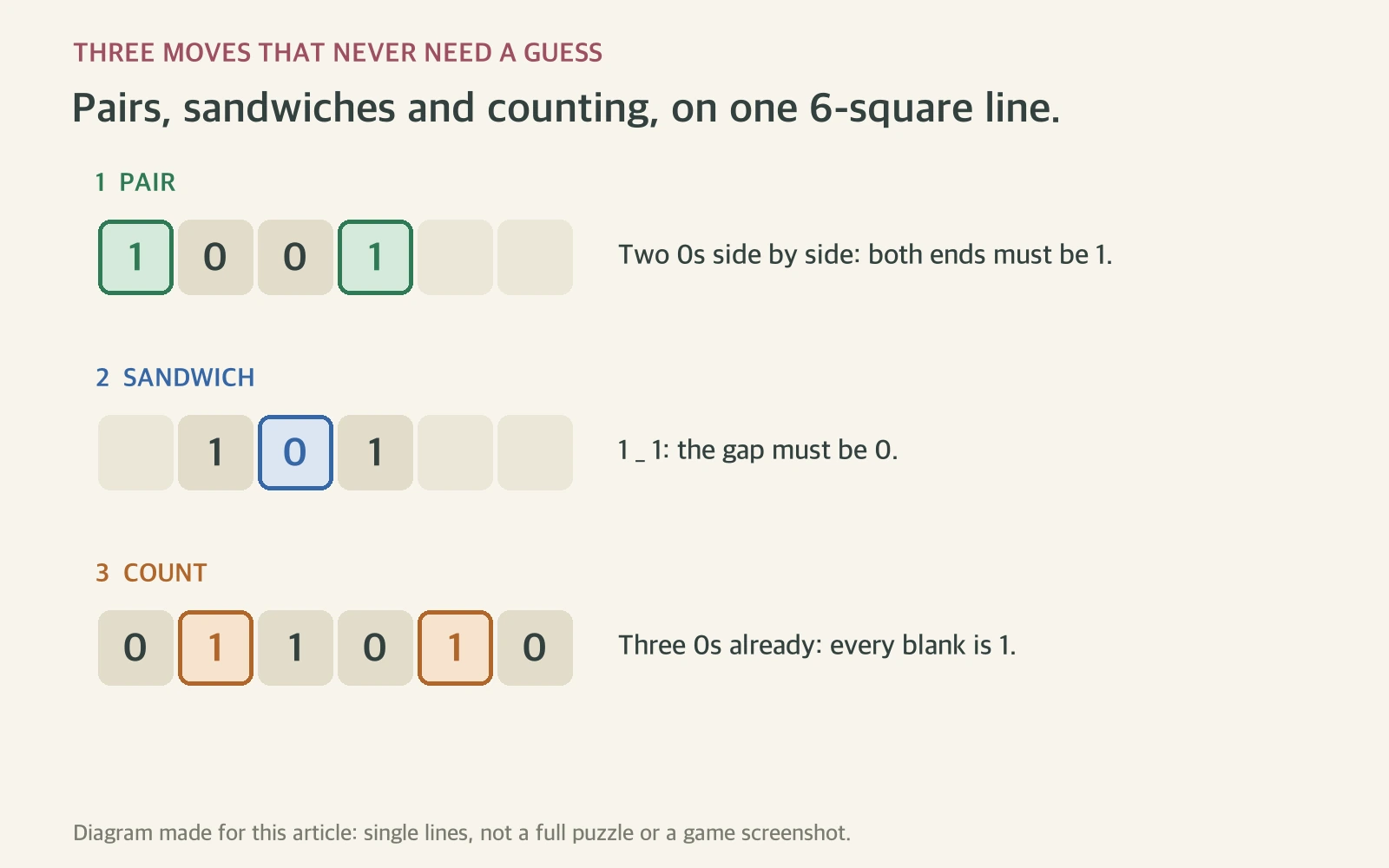
- Pair. Two equal digits side by side must have the opposite digit on both ends. A third would break rule 2.
- Sandwich. Two equal digits with one gap between them, such as 1 _ 1, force the opposite digit into the gap.
- Count. Once a row or column has its full share of one digit (three on a 6×6 grid), every blank in that line gets the other digit.
After each move, check the crossing line: a digit placed in a row is new information for its column. Rule 4 matters mostly near the end, when two lines are nearly full.
A 6×6 binary puzzle to try
We made this puzzle for this article and checked it with a small program: it has exactly one solution, and pairs, sandwiches and counting alone are enough to finish it. A dot is an empty square.
. 1 . . . .
1 1 . . . .
. . 0 . 1 .
. . . . . .
0 . . 0 . 0
. . . . . .
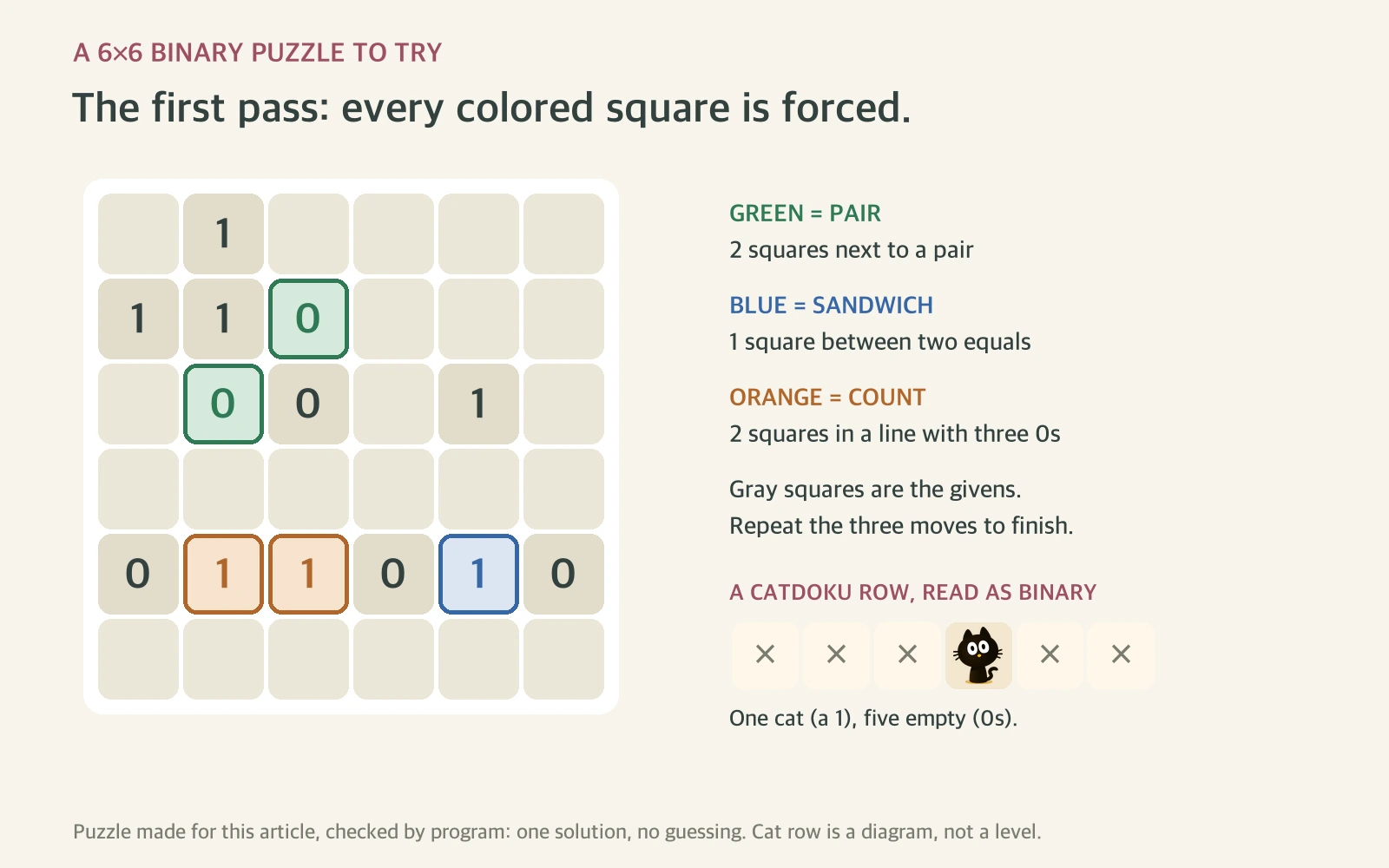
The first pass gives five squares:
- Row 2 starts 1 1, so the square after them is 0 (pair).
- Column 2 starts 1 1, so the square below them is 0 (pair).
- Row 5 already has three 0s, so its three blanks are 1s (count). One of them also sits between two 0s (sandwich).
Keep going with the same three moves. Answer, row by row: 011001, 110010, 100110, 001101, 011010, 100101.
What if the three moves stop working?
If a full pass places no digit, Wikipedia's article describes two next steps:
- Rule out the impossible. Try a digit in a square and follow it. If it forces three in a row or too many of one digit, the square must hold the other digit.
- Use "no identical lines". If a row is two squares away from matching a finished row, fill those two squares the other way round.
A fact we checked by program: on a 6×6 grid, only 14 different lines satisfy rules 1 to 3.
Binary puzzles and Catdoku
A Catdoku board is a binary grid as well. Every square either holds a cat or is empty. In the app, one tap marks a square as empty and two quick taps place a cat.
The counting rule is different. A binary row on a 6×6 grid needs three 1s. In Catdoku, each row, column, and colored region needs exactly one cat. Two of the moves above carry over almost directly:
- Count. When a line or region already has its cat, every other square in it is empty. The app's tutorial says it this way: "This color already has its cat, so its other cells must be empty."
- Pair. In a binary puzzle, two equal neighbors force the squares around them. In Catdoku, a single cat forces its neighbors, because cats cannot touch, not even diagonally.
- The reverse count. When only one square in a line can still hold a cat, the cat goes there. Catdoku's hint calls this "Only one spot".
The nonogram guide uses the same empty-square marking with number clues.
Try it
- In binary puzzles: look for pairs and sandwiches first, then count each line, then check the crossing lines.
- The cat version: the free daily puzzle has three new boards every day: Easy 6×6, Normal 8×8, and Hard 9×9.
- More boards: the app has 5,000 levels from 4×4 to 12×12, and hints that explain why each move works.