
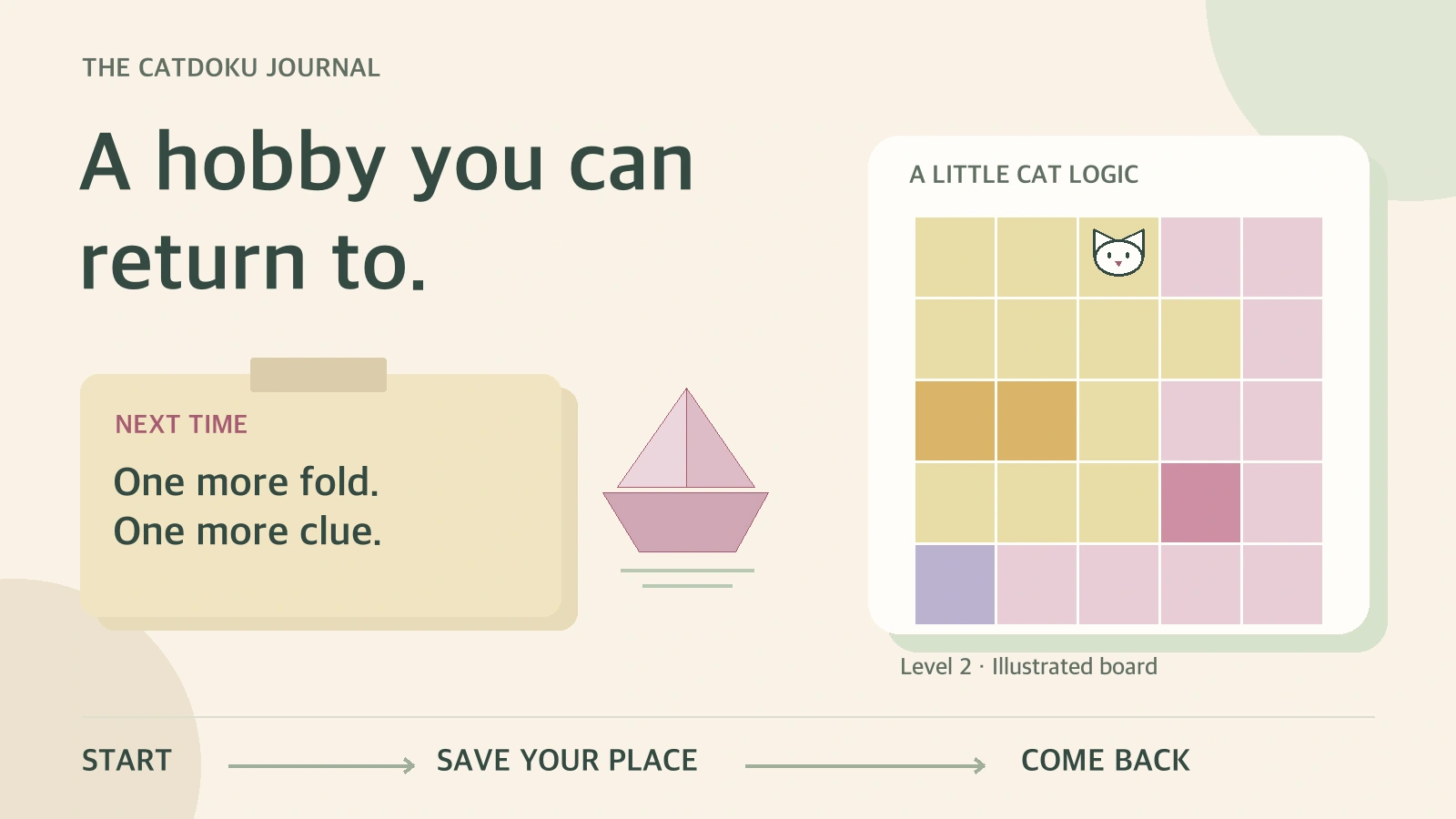
For a hobby that fits a busy life, choose something you can set up easily, put away midway, and recognize when you return. A small sketchbook, a paper-folding project, a photo collection, or a Catdoku board can give you a starting point. Pick the one whose next step sounds enjoyable to you.
An uneven schedule can still have room for an interest you keep coming back to. The useful question is how the hobby fits around your actual classes, work, shared space, and other commitments. You get to choose its size.
Check what it takes to begin again
Before buying supplies or planning a routine, picture yourself returning to the activity on an ordinary day. Check three things:
- Setup: What needs to come out of a drawer, charge, or be cleared away before you can start?
- A place to pause: Can you leave the activity unfinished? What will keep your place?
- A next step: When you return, will you know what you wanted to try?
A hobby that lives in a small pouch may suit a shared desk. A phone-based puzzle may suit someone who wants to carry the activity without extra equipment. If you enjoy spreading materials across a table, choose a time and place where they can stay out.
Use those conditions to narrow your choices. There is no need to make every hobby fit every spare moment.
Four hobbies you can make your own
These starting points let you try the activity with a small scope. Use supplies you already have where possible.
Small sketches
Draw one object on your desk with a pencil or pen. When you put the sketchbook away, leave a bookmark beside the drawing and name the next object you'd like to try.
Paper folding
Choose one simple model and follow its instructions. Keep the paper with those instructions and mark your last completed step, so you can find the next fold when you return.
A photo collection
Choose a theme such as interesting shadows or doorways. Keep the photos in one album and write your next theme in its title or a note. Your collection can grow from details in places you already visit.
Catdoku
Open your current normal level and explore a colored region. Return to the saved board on the same device and revisit the region you were checking.
Try the sketchbook if making something by hand appeals to you. Try a photo collection if you enjoy noticing details in places you already visit. Paper folding offers a sequence to follow; Catdoku offers a set of rules to investigate.
You can keep the results private. A page of drawings, a few folded shapes, or a puzzle you enjoyed is enough to make the activity yours.
Give a Catdoku board a place in the week
For a portable hobby built around little discoveries, we recommend Catdoku. The mobile game asks you to place one cat in each colored region, row, and column, with no touching cats, including diagonally.
Start your current normal level and choose a region to inspect. Tap to mark a square; double-tap to place a cat. Look for a move you can explain from the rules, then follow what it changes elsewhere on the board. Our Catdoku strategy guide gives a worked example of a region that reserves a row.
The current normal board saves on your device, so you can return to that attempt later. Before leaving, notice which region you want to examine next. That small question gives your next visit a starting point.
You can play today's free puzzle on our website to see whether you enjoy the rules. The saved normal-board progress described here belongs to the mobile game.
Catdoku is free to download on iPhone and Android, with ads and optional in-app purchases.
Try one choice during an ordinary week
Here's a simple experiment: pick one hobby for the coming week and give yourself a couple of opportunities to return to it. Choose moments that already have some room, and adjust when your plans change.
A student might keep a sketchbook beside their reading materials and return to the same page on another afternoon. Someone with changing work hours might open their saved Catdoku board when they feel like a puzzle, then leave it for another day.
After you've tried returning, ask: Did I enjoy the activity? Was getting started manageable? Is there something I'd like to try next? Keep what worked, shrink the setup, or choose another activity. A missed day leaves you free to continue whenever it suits you.
If a colorful logic puzzle sounds like something you'd enjoy coming back to, make Catdoku your first experiment.
Find your next Catdoku board →
Want to share the discoveries? Try our puzzle night ideas for taking turns and talking through one board with a friend.