
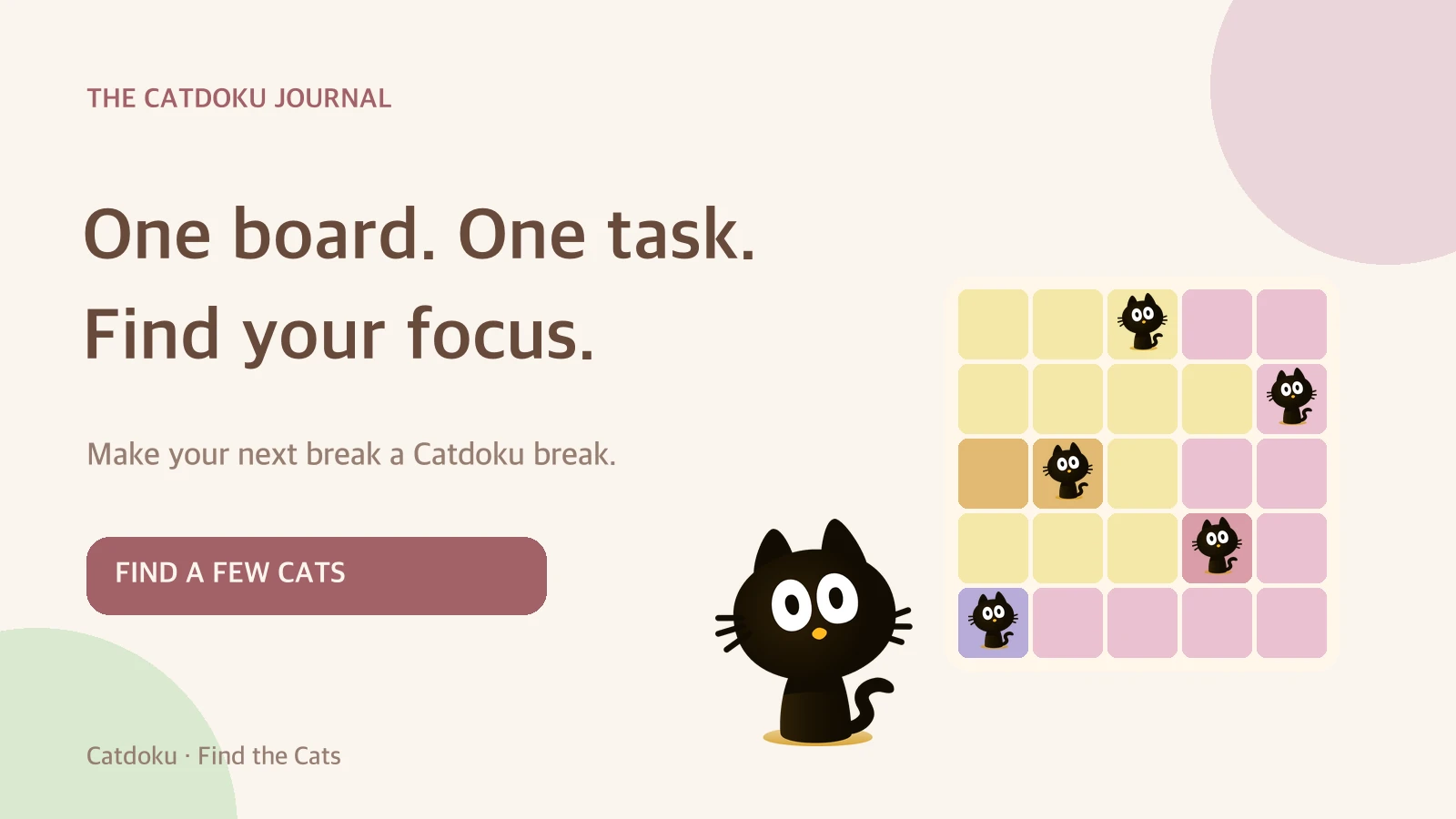
Too many tabs open—in your browser and in your head? Make your next break a Catdoku break. Give yourself a small puzzle, follow one rule, and look for the next cat. When the break ends, return to one clearly defined piece of studying or work.
For students juggling assignments and people jumping between meetings, that is the routine we're recommending: a little logic, a few cute cats, and a moment with one task in front of you.
Why we're recommending Catdoku for your next focus break
Catdoku gives you a specific job: find the cats hidden across a colorful board. Each color region needs one cat. Each row and column needs one cat. Cats cannot touch, even diagonally.
You make progress by looking carefully, ruling out a position, and checking what that means for the next move. There is always a concrete question to return to: what can I work out from this square?
That makes Catdoku a natural choice when you want a break built around a small, deliberate task. We're recommending it as something enjoyable to practice paying attention to, alongside the everyday habits that support your study or work.
You can explore the three rules and try the board on our homepage.
Turn one puzzle into a deliberate attention exercise
You don't need to rush through a whole level. Try this approach on your next board:
- Pick one color. Look at every square in that region before tapping.
- Follow one rule. Check whether a cat already occupies the same row or column.
- Explain one move. Before placing a cat or marking a square, say why that position works or cannot work.
- Check what changed. Use the new information to choose the next square to inspect.
This is a way to approach the puzzle thoughtfully. The activity asks you to notice details, hold the rules in mind, and make one decision at a time.
If your thoughts wander, you have a simple place to restart: the region you were checking. No need to judge the whole session. Just find your next move.
A practical routine for studying or working
Make the puzzle part of a break with a beginning and an end. Here is an example to adapt to your day:
| Moment | What to do |
|---|---|
| Before a study or work session | Write one finishable task, such as “outline three paragraphs” |
| During the session | Keep the material you need in front of you and set aside avoidable notifications |
| At your planned break | Stand up and move, then play a short Catdoku puzzle if you want a little logic time |
| Before returning | Close the game and write the next action for your original task |
A board or a short timer can give the puzzle break a boundary. If it is time to return, the remaining cats can wait for your next pause.
For students: one question, then one paragraph
Between study sessions, open a board and explain a single move to yourself. When you return to your notes, keep that same concrete approach: choose one question to answer or one paragraph to work through.
If you are reviewing material, close the notes briefly and write what you remember before checking. That is retrieval practice, a learning approach studied by Karpicke and Blunt. The study concerns learning from science texts; the Catdoku routine here is our practical suggestion for your break.
For working adults: a small pause between bigger tasks
After finishing a meeting or a piece of work, note where you need to resume. Use your break for a little movement and, if you feel like it, a few Catdoku moves. Then reopen your document at the next specific action.
During work itself, limit avoidable task switching where your role allows it. The American Psychological Association's research summary explains the costs of switching between tasks. Keep urgent communication available when your job requires it.
Keep the habits that support the rest of your day
A good puzzle break belongs alongside enough sleep, regular movement, and time spent on the thing you actually want to learn or finish. The CDC describes how sufficient sleep supports attention and memory; its physical activity guidance offers ways to add movement to the day.
We recommend Catdoku for the puzzle experience: observing, checking rules, and making deliberate moves. Improvements in school, work, or attention outside the game are separate outcomes, and we haven't measured them for Catdoku.
Your next small challenge is waiting
Close a few tabs. Choose one board. Find the next cat.
If you want a more intentional study or work break, give Catdoku a place in your routine. Start with one region and enjoy the moment when the logic clicks.
For the end of the day, try a cozy Catdoku evening ritual.
Further reading
Reviewed November 1, 2026. These sources cover general learning and lifestyle habits, not measured effects of Catdoku.